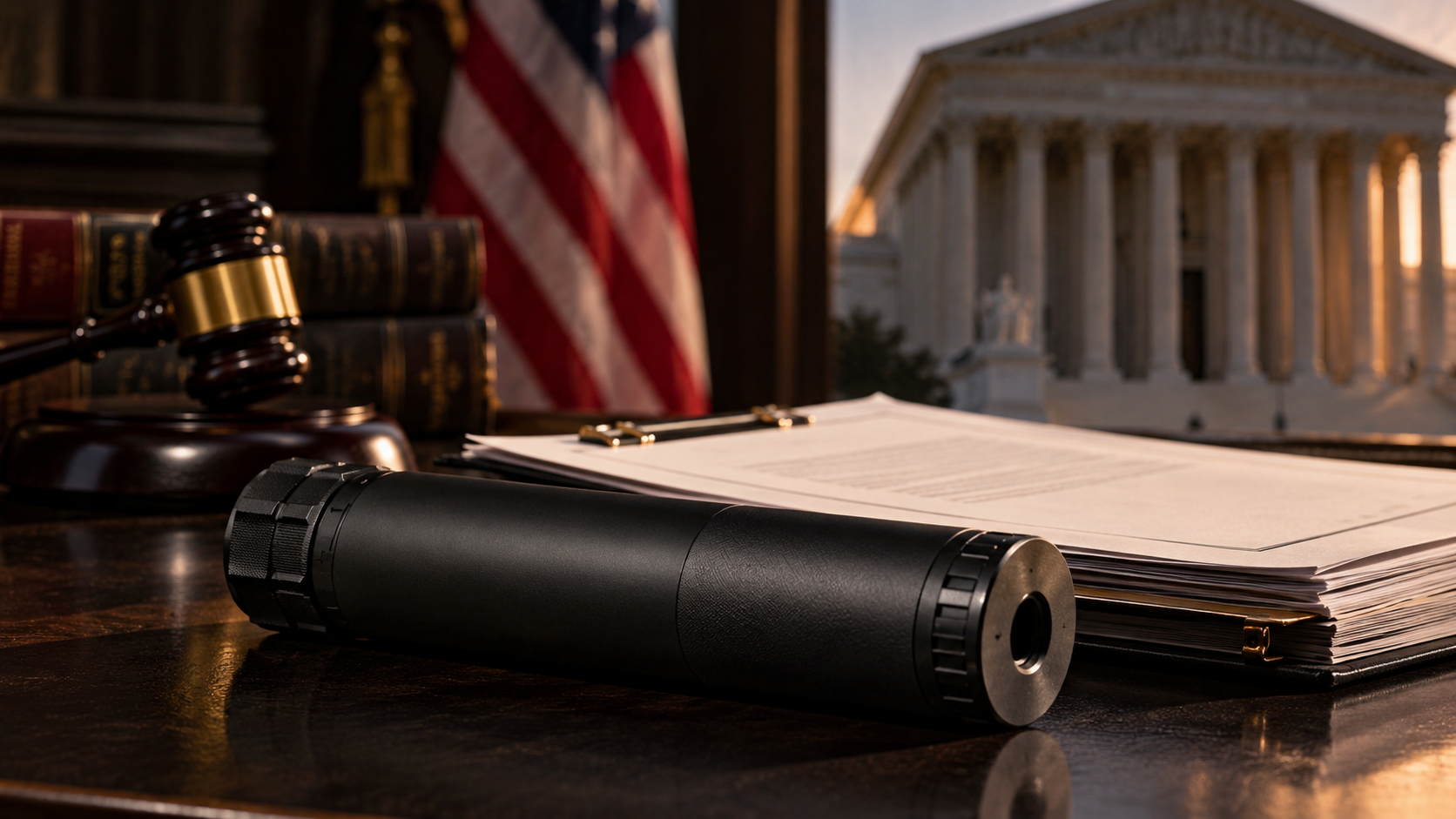
A major federal firearms ruling reaches a new stage
The U.S. Department of Justice has decided not to appeal the federal district court ruling in Silencer Shop Foundation v. ATF, a case that challenged the continued enforcement of National Firearms Act registration and approval requirements after Congress reduced the federal making and transfer taxes on suppressors and certain other NFA firearms to zero.
The decision is significant because it removes the federal government's planned appellate challenge to an August 5, 2026 ruling by U.S. District Judge James Wesley Hendrix of the Northern District of Texas. The court held that the challenged NFA provisions exceeded Congress's Article I enumerated powers when applied to firearms whose NFA making and transfer taxes had been reduced to $0. The court did not decide the case under the Second Amendment.
DOJ will not take the case to the Fifth Circuit
Solicitor General D. John Sauer informed Congress that the Justice Department had determined not to file an appeal. The decision was dated September 24 and became public through a court filing on October 1, just before the government's appeal window closed.
That matters because the August ruling had been stayed for seven days to give the government an opportunity to seek appellate relief. The stay expired on August 13, allowing the permanent injunction to take effect. With DOJ declining to appeal, the district court's judgment is no longer facing a government appeal in the Fifth Circuit.
In practical terms, this is a significant change from August, when the long-term status of the ruling remained uncertain. The government's decision not to appeal means the injunction remains in place rather than being placed at immediate risk through an appellate challenge by DOJ.
What Judge Hendrix actually ruled
The court's August 5 memorandum opinion and order focused on the relationship between the NFA's regulatory requirements and the taxes that historically supported them. Congress had eliminated the making and transfer taxes for suppressors, short-barreled rifles, short-barreled shotguns and certain other weapons beginning January 1, 2026.
Judge Hendrix concluded that the challenged regulatory provisions could not continue to be justified under Congress's taxing power once the relevant taxes had been reduced to zero. The court therefore found those provisions unconstitutional as an exercise of Congress's enumerated powers and entered a permanent injunction against their enforcement as to the plaintiffs and, where applicable, their members and customers.
One important detail is easy to miss: the court specifically declined to enter a universal injunction. The opinion explains that federal equitable relief must be tailored to the parties before the court. That means the ruling should not be described as a nationwide repeal of the NFA or as an automatic exemption for every suppressor owner in the United States.
Suppressors are at the center of the story
Suppressors have received much of the public attention because they were historically subject to the NFA's registration and transfer system, including the $200 federal transfer tax. The 2026 tax change removed that $200 tax for suppressors, while the litigation challenged the regulatory requirements that remained attached to the untaxed category.
The court's ruling did not make suppressors legal in every circumstance or erase other federal or state firearm laws. Instead, it addressed the specific NFA provisions challenged by the plaintiffs and the government's authority to enforce those provisions against the parties protected by the injunction.
What the DOJ decision does not mean
The NFA has not been repealed. The decision not to appeal also does not mean every NFA category is suddenly treated the same way. The court's opinion expressly distinguished categories that remain subject to NFA taxes, including machine guns and destructive devices, and it did not eliminate the separate special occupational tax applicable to NFA businesses.
Likewise, the decision is not a nationwide Second Amendment ruling. Judge Hendrix specifically stated that the court did not need to reach the plaintiffs' Second Amendment claims because the plaintiffs were entitled to relief under their Article I argument.
State law also remains relevant. A state can impose its own restrictions, and dealers may use different procedures depending on the jurisdiction and the legal guidance available to them.
Why the no-appeal decision matters for the firearms industry
For the firearms industry, the decision creates an unusual moment in federal regulatory history. A court has concluded that portions of a nearly century-old regulatory framework cannot continue to rest on a taxing power after the underlying tax has been reduced to zero—and the federal government has now chosen not to ask the Fifth Circuit to reverse that decision.
Manufacturers, retailers, suppressor companies and industry service providers will now have to operate within a legal environment shaped by the injunction, ongoing ATF guidance and the possibility of future litigation or congressional action.
For collectors and historians, the case is also a useful example of how firearms law can change through the interaction of legislation, litigation and executive-branch policy. The practical rules surrounding a familiar category of regulated firearms can change without Congress formally repealing the entire statute.
What comes next?
The immediate question is implementation. The court's ruling and DOJ's decision not to appeal settle one major procedural issue, but they do not answer every question about how federal agencies, manufacturers and dealers will handle transactions going forward.
ATF guidance and the policies adopted by individual dealers will remain important. Additional lawsuits could also test the boundaries of the injunction or seek broader relief. Congress could separately amend the NFA in the future.
For that reason, headlines describing the NFA as simply “gone” are misleading. A more accurate description is that a federal court found specified NFA provisions unconstitutional as applied to untaxed firearms, entered a permanent injunction for the covered parties, and the Department of Justice has now chosen not to appeal that judgment.
This article is an original editorial summary by Jonathan Herrera based on the federal court's August 5, 2026 opinion and publicly reported confirmation of the Department of Justice's decision not to appeal. It is intended as news and legal-policy reporting, not legal advice. Federal and state requirements can change, and readers should verify current requirements through authoritative sources.
Primary court record: U.S. District Court, Northern District of Texas — Document 136
DOJ decision confirmation: U.S. Senator Cynthia Lummis — September 23, 2026 statement
Additional reporting: Outdoor Life — October 5, 2026
READER DISCUSSION
Have something to add?
Share a historical observation, correction, research lead or perspective related to this article. Comments are reviewed by the editor before publication.