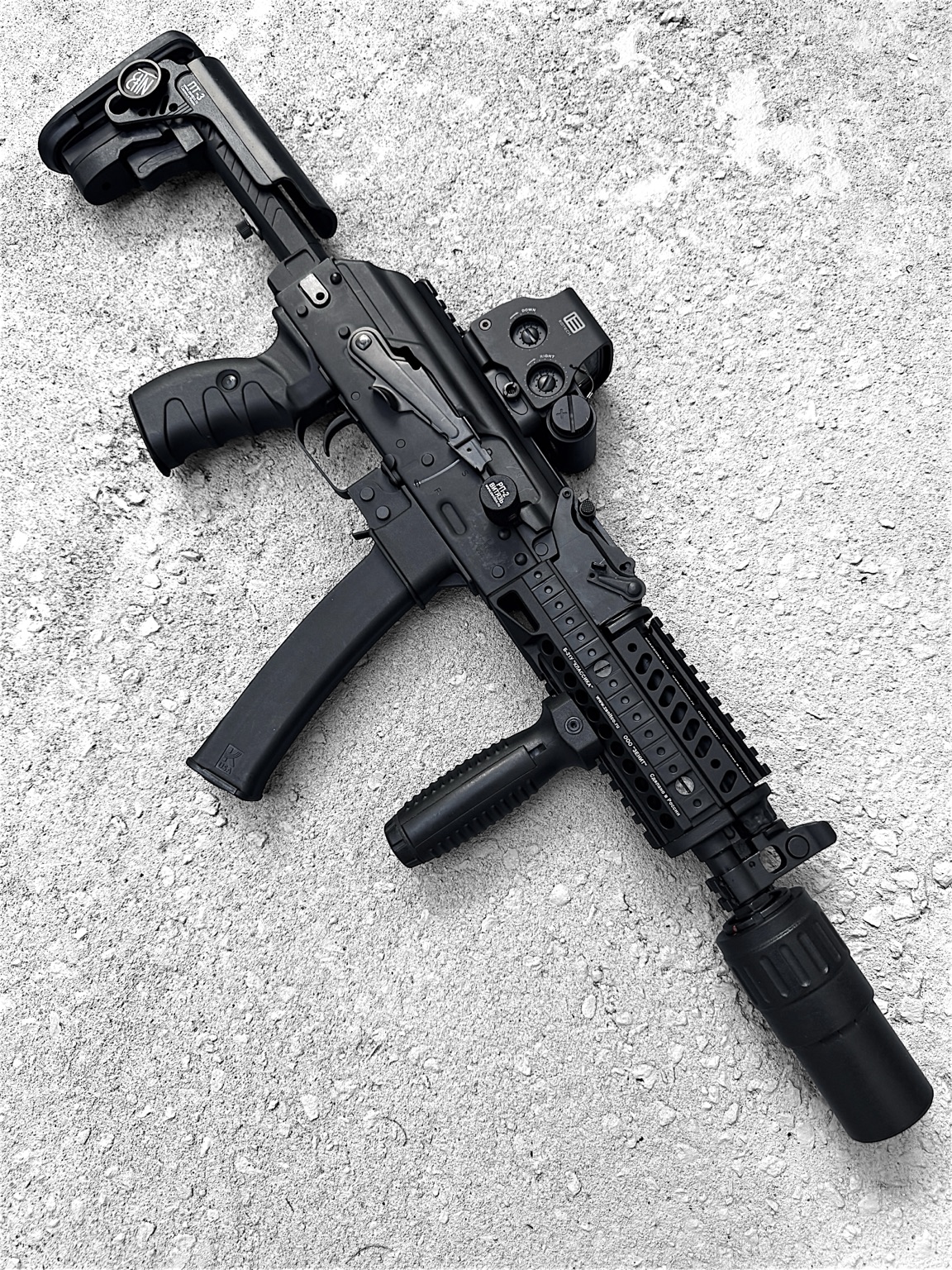
Some of the most interesting developments in the modern suppressor market are not coming from the largest names in the industry. They are coming from smaller manufacturers willing to use newer manufacturing methods, rethink internal geometry and build products around a very specific design philosophy.
Stealth Additive Works (SAW) is one of those companies. The Idaho-based manufacturer has attracted attention for its approach to additive manufacturing and for a product line that includes compact suppressor designs intended to make efficient use of limited space. Its Tisha has become the company's most recognizable example of that philosophy, and Florida Kalash Media recently had the opportunity to evaluate the Tisha 9mm on a Vityaz platform.
A manufacturer built around additive manufacturing
The name Stealth Additive Works is a useful introduction to the company itself. SAW's identity is closely tied to additive manufacturing—the ability to create complex metal structures that can be difficult to reproduce through conventional machining alone.
That matters in suppressor design because the internal volume of a suppressor is effectively a three-dimensional engineering problem. Designers are trying to manage expanding gases, heat, pressure and flow within a relatively small envelope. Additive manufacturing can provide another level of freedom when shaping those internal structures.
SAW's Tisha is a particularly visible example of that philosophy. Independent testing by PEW Science of the 5.56 version documented a compact titanium design and highlighted staged flow paths, annular structures and complex internal geometry. That testing is not a substitute for our 9mm evaluation—the cartridges, host platforms and test methods are different—but it provides useful context for understanding why the Tisha has attracted attention beyond its physical appearance. PEW Science research →
The Tisha concept
The Tisha stands out visually because it does not look like a conventional stack of simple cylindrical baffles. Its exterior reflects the same design philosophy visible in the company's manufacturing approach: compact dimensions paired with geometry intended to make efficient use of available volume.
PEW Science's published evaluation of the 5.56 Tisha described it as a next-generation hybrid design and measured the rifle-caliber version at approximately 4.13 inches without a mount. The laboratory also emphasized that its results applied specifically to the tested 5.56 host system and should not be generalized to other cartridges or firearms. Read the full test →
That distinction is important here. Our experience was with the 9mm Tisha on a Vityaz, not the 5.56 model evaluated by PEW Science. We are therefore not presenting PEW Science's numerical results as measurements of the 9mm model.
Our Vityaz evaluation
The Vityaz is a fitting host for this review. Its compact proportions and 9mm chambering make it a natural environment for evaluating how a suppressor integrates into a pistol-caliber Kalashnikov-style system without allowing the suppressor to overwhelm the overall package.
From a practical editorial standpoint, what immediately stood out was the balance of the finished configuration. The Tisha presents as a compact, modern component rather than an oversized addition to the firearm. The overall package in our photographs remains visually coherent, with the suppressor complementing the Vityaz's compact proportions.
During our evaluation, the Tisha delivered the experience we were looking for from a modern 9mm suppressor: a noticeably more subdued firing signature and a configuration that remained manageable as a complete system. This was a hands-on editorial evaluation rather than a laboratory sound-metering project, so our observations should be understood as field impressions rather than quantified acoustic data.
Where the Tisha fits in the market
The most interesting part of the Tisha is not simply that it is another 9mm suppressor. It represents a broader trend in the suppressor industry toward smaller, more specialized manufacturers using advanced manufacturing techniques to challenge conventional design assumptions.
For years, suppressor development was largely associated with familiar baffle architectures and manufacturing processes. Additive manufacturing has expanded the design vocabulary. Companies can now experiment with complex internal structures and shapes that are much more difficult to reproduce through traditional machining.
SAW's approach places it within that newer generation of manufacturers. The company is not trying to make the most visually traditional suppressor; it is using manufacturing capability as part of the design process itself.
The 9mm Tisha in context
Independent 2026 testing from other reviewers has also placed the Tisha 9mm into the growing field of lightweight pistol-caliber suppressors. A recent comparison from Silencer Analytics evaluated the 9mm Tisha alongside another lightweight 9mm suppressor on a roller-delayed pistol-caliber carbine, highlighting differences in design philosophy and perceived sound. That work is useful as outside context, but it was performed on a different host and under a different methodology than our Vityaz evaluation. Silencer Analytics comparison →
That broader context is important because suppressor performance is highly system-dependent. Ammunition, host firearm, barrel length, operating system and measurement position can all influence the result. A responsible product review should separate manufacturer claims, independent laboratory measurements and first-hand impressions rather than blending them into one number.
Design over spectacle
One of the things we appreciate about SAW is that the Tisha is interesting even when viewed as an engineering object rather than simply a shooting accessory. The external form follows from a manufacturing philosophy, and the internal architecture is part of the story.
For collectors, that is increasingly relevant. Modern firearms collecting is no longer limited to historically significant military arms. Today's collectors are also documenting the technologies that are changing how firearms and accessories are designed and manufactured. Early examples of additive-manufactured suppressors may eventually become useful artifacts in the history of firearms manufacturing.
The Tisha is particularly noteworthy in that context because its development illustrates a period when additive manufacturing moved from an emerging production method into a serious tool for suppressor engineering.
Our take
Stealth Additive Works is a company worth watching because it represents a different path through the modern firearms industry. Rather than competing solely through scale or brand recognition, SAW is using manufacturing technology and engineering-driven design to carve out its own space.
Our experience with the Tisha 9mm and Vityaz reinforced that impression. The finished configuration is compact, visually purposeful and representative of a newer generation of suppressor design. While our evaluation was not a controlled acoustic test, the Tisha made a strong impression as a modern product that feels deliberately engineered rather than simply incremental.
For Florida Kalash Media, that is ultimately what makes SAW interesting. The company is not only producing a suppressor; it is part of a larger shift in how firearms components can be designed, manufactured and documented.
This article combines Florida Kalash Media's first-hand editorial evaluation of the Stealth Additive Works Tisha 9mm on a Vityaz platform with publicly available information and independent third-party research. Our observations are field impressions and are not presented as laboratory sound-level, durability or recoil measurements.
The PEW Science data cited in this article concerns the 5.56 Tisha on a specific MK18 test platform and is not a performance claim for the 9mm model reviewed here. PEW Science has described the 5.56 Tisha as a compact titanium suppressor incorporating advanced hybrid design principles.
Suppressors are safety-critical products. Readers should consult the manufacturer's current documentation for compatibility, use limitations and maintenance requirements. SAW's published warranty notes that its products have specific restrictions concerning caliber, rate of fire, barrel length and mounting configurations. SAW warranty →