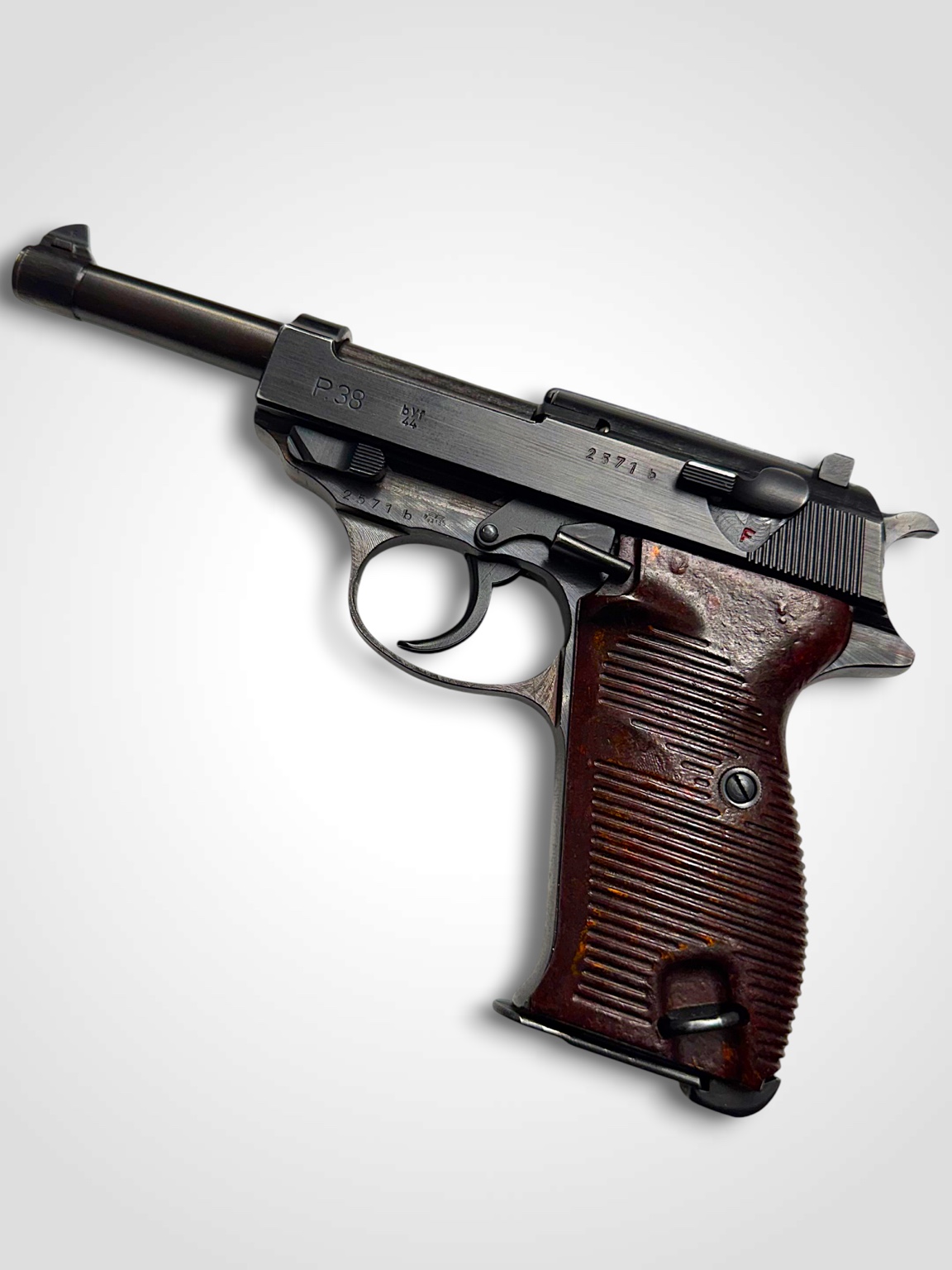
A firearm is a snapshot of an industrial system
Collectors often approach a historic firearm as though it should have a single, permanent set of characteristics: one finish, one type of component, one style of marking and one accepted configuration. That model works reasonably well for a modern commercial product, but it can be misleading when applied to a weapon produced during a major war.
Wartime production was an evolving industrial process. Governments placed enormous contracts, manufacturers expanded facilities, companies brought in subcontractors, and existing designs were repeatedly evaluated for ways to increase output without sacrificing the requirements that mattered most. The result was not necessarily a new model every time something changed. More often, the same basic firearm moved through a series of production states.
That is why two examples of the same model can look surprisingly different while both remaining historically correct. The differences are often not defects or evidence of later alteration. They can be records of when, where and under what conditions a firearm was made.
War creates pressure on every part of production
The first pressure is simple: quantity. Once a military enters a large-scale conflict, demand can rise faster than an established manufacturer was designed to handle. Existing machinery has to work harder, additional shifts may be added, and new suppliers may be brought into the program.
World War II provides numerous examples. American production expanded across a network of established arms companies and firms that had not traditionally been primary firearms manufacturers. The M1911A1, for example, moved from a relatively concentrated prewar manufacturing base into a wartime program involving several contractors. Remington Rand ultimately produced almost 900,000 pistols, while other contractors also contributed to wartime supply. citeturn0search5
The important point for collectors is that production scale changes the meaning of the word standard. A military specification can define what the finished firearm must accomplish without requiring every factory to manufacture every component in exactly the same visual manner.
Materials change when the supply chain changes
One of the most visible effects of wartime production is substitution. A manufacturer may have started with a preferred material or finishing process and later adopted something less expensive, more available or faster to process.
Those substitutions can affect almost anything a collector can see: surface finish, grip material, small fittings, stocks, fasteners and other components. The change may be temporary, may appear at one factory before another, or may overlap with an earlier practice because existing inventory was still being consumed.
This is one reason a collector should be cautious about statements such as “all examples from this year have this feature.” Real production lines rarely change on January 1. Existing parts can remain in bins, contracts can overlap, and different factories can reach the same solution at different times.
The P.38 is a good example of production evolution
The German P.38 illustrates how wartime demand could broaden a manufacturing program. After the pistol was adopted for military service, Walther's production was not sufficient by itself to satisfy demand, and additional manufacturers were brought into the program. Mauser at Oberndorf began producing the P.38 in 1942, while Spreewerk also became a major wartime producer. citeturn0search1
Those manufacturers did not simply create identical copies with different names. Their production histories, tooling and finishing practices produced identifiable differences. Mauser examples can be encountered with phosphate finishes, for instance, while manufacturer codes and inspection markings changed as the German system evolved. citeturn0search1
For a collector, that makes the markings more than decoration. A manufacturer code, date and inspection mark can form part of a chronological chain. The surrounding details then become a way to test whether the physical configuration makes sense for that particular production period.
The M1911A1 shows how contractors can create legitimate variation
The American M1911A1 offers a different version of the same story. The basic design was standardized, but wartime production required multiple companies to manufacture the pistol. Remington Rand's production is particularly instructive because the company initially encountered parts-interchangeability problems, then corrected them as production matured. It also obtained components from multiple sources, including Colt, Springfield Armory and High Standard. citeturn0search5
That history helps explain why a collector should not evaluate a wartime pistol solely by whether every visible component carries the same manufacturer's mark. Large military production programs were supply networks. Components could come from subcontractors or government facilities while the completed firearm remained a legitimate product of the prime contractor.
The larger lesson is that variation and authenticity are not opposites. In a properly documented wartime firearm, variation can actually be evidence of the production environment.
Sometimes the change is about speed, not design
Manufacturers also simplified production to reduce labor and machine time. A part that once required extensive machining could be redesigned for stamping. A cosmetic step could be reduced or eliminated. A finish could be changed. A complicated component could be replaced with a simpler one if the new version still met the military requirement.
The wartime M3 submachine gun is an especially clear example of production philosophy changing to meet demand. Guide Lamp's M3 production relied heavily on sheet-metal stampings, and by June 1944 the plant was producing roughly 1,000 M3s every 24 hours. The design's manufacturing approach was deliberately suited to high-volume production, with the receiver formed from stamped halves that were welded together. citeturn0search3
These decisions were not necessarily about making a “cheaper” firearm in the modern sense. They were about allocating industrial resources to the features that mattered most while removing unnecessary time and complexity from the manufacturing process.
Even the same model can reflect different factories
Another reason wartime firearms vary is that production can be distributed among different facilities. A government may have a specification for a rifle or pistol while several companies manufacture it simultaneously. Each company brings its own machinery, workforce, suppliers and established manufacturing habits to the program.
The Savage-produced No. 4 Lee-Enfield is a useful example. Savage-Stevens manufactured receivers, bolts, trigger guards and stocks while other parts could come from subcontracted sources. Distinctive manufacturer marks on individual components can therefore tell part of the production story. citeturn0search2
For the collector, this means that a component mark is not automatically evidence of a mismatch. It has to be considered alongside the model, serial range, contract, production date and known practices of the manufacturer.
Markings are a research tool, not a shortcut
Historic markings are among the most useful clues available to a collector, but they are easy to overinterpret. A code can identify a manufacturer. A date can establish a production period. An inspection mark can indicate government acceptance. A serial number can help establish where an example falls within a production run.
None of those clues should be treated in isolation.
A firearm's physical characteristics should agree with its documented production history. If a dated example has a feature normally associated with a different period, the correct response is not immediately to declare it wrong. The discrepancy becomes a research question. Was the feature introduced earlier than expected? Did the factory use remaining inventory? Was the firearm rebuilt later? Was the component supplied by another contractor? Was the marking interpreted incorrectly?
This approach is especially important with military firearms because many remained in service long after they left the factory. Original production characteristics and later service history can exist on the same object.
Production changes can tell a story about logistics
One of the most interesting aspects of wartime collecting is that a small physical detail can point toward a much larger industrial story.
A change in finish may reflect the availability of chemicals or processing capacity. A different grip material may reflect a shortage of a preferred material. A simplified machined part may indicate an effort to reduce machine time. A new contractor code may reveal an expansion of production. A different component supplier can show how widely a program's supply chain had grown.
In other words, the firearm becomes an industrial artifact. Its markings and components preserve evidence of the system that produced it.
Why “factory original” requires careful language
Collectors often use terms such as “all original,” “matching,” “correct” and “factory configuration.” These can be useful, but they should be supported by evidence.
A firearm can contain period-correct replacement components and still be an important historical object. Conversely, a firearm that appears visually consistent can contain a later replacement that is not obvious without research. Military rebuild programs further complicate the picture because arsenals commonly returned worn weapons to service using a mixture of replacement and serviceable parts.
That is why provenance matters. Documentation, photographs, veteran or family history, import records, arsenal markings and long-established collection histories can sometimes explain changes that the firearm itself cannot.
How collectors should read variation
A useful way to approach wartime production is to move from observation to research rather than from observation directly to a conclusion.
First, document what is actually present. Record markings, dates, serial numbers, finish characteristics and unusual components without immediately deciding what they mean.
Second, establish the production context. Identify the manufacturer, contract and approximate production period. Determine whether multiple factories or subcontractors were involved.
Third, compare multiple authoritative references. Production changes are often documented in specialized collector literature, factory records, military documentation and detailed photographic references. One source may describe the general rule while another documents an exception.
Finally, separate factory history from later service history. A firearm's current configuration is not necessarily the configuration in which it left the factory. That distinction is essential when discussing originality and provenance.
Variation is part of the history
The most valuable lesson in wartime firearms collecting is that variation should not automatically be treated as a problem to solve. It can be the subject of the research itself.
Wars forced manufacturers to adapt. Designs were simplified, suppliers changed, production moved between factories, materials became scarce and output requirements increased. The firearms that survive today preserve those decisions in steel, wood, polymer, markings and finish.
When a collector learns to recognize those changes, a firearm becomes more than a model name and a date. It becomes evidence of an industrial process — a physical record of how manufacturers responded to extraordinary demands.
That is what makes wartime production so valuable to study. The differences are not merely imperfections in a standardized product. They are often the details that tell us how the product was actually made.
This educational feature is intended as a starting point for historical research. Production practices varied by manufacturer, contract and period, and identification or dating should be confirmed against specialized references and primary documentation when available.
Selected sources
Small Arms Review — The German P.38 Pistol
American Rifleman — The G.I. .45 in World War II
Small Arms Review — WWII Grease Guns: How GM Helped GIs
Small Arms Review — The WWII Savage Enfield
American Rifleman — The Smith-Corona Model 1903A3s
READER DISCUSSION
Have something to add?
Share a historical observation, correction, research lead or perspective related to this article. Comments are reviewed by the editor before publication.