A different kind of wartime sidearm
When World War II American small arms are discussed, the M1911A1 usually dominates the conversation. It was the standard U.S. service pistol, chambered in .45 ACP and built for the demands of conventional military service. But the American wartime handgun inventory was broader than the iconic .45.
Among the less conspicuous pistols was Colt's Model 1903 Pocket Hammerless. Designed by John Browning and introduced commercially in .32 ACP, the compact pistol had already spent four decades on the civilian market when the United States entered World War II. Its small dimensions and unobtrusive profile made it useful for assignments where a full-size service pistol was not the priority.
The wartime examples are particularly interesting to collectors because the government did not simply take an old commercial design and give it a military marking. Colt produced a distinct run of pistols for government procurement, and those examples provide a window into how the U.S. military and intelligence establishment sourced specialized sidearms during the war.
Reading the markings
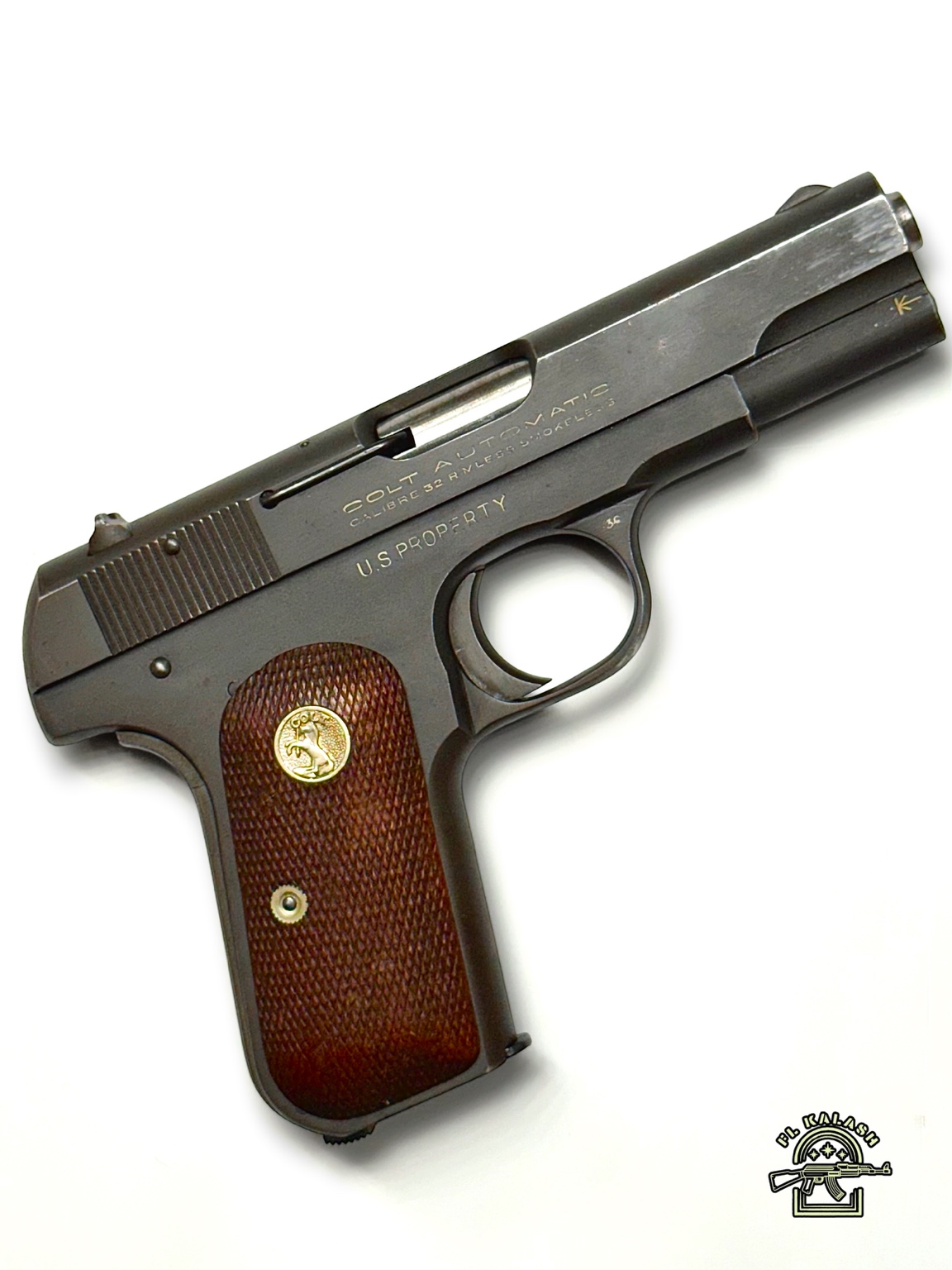
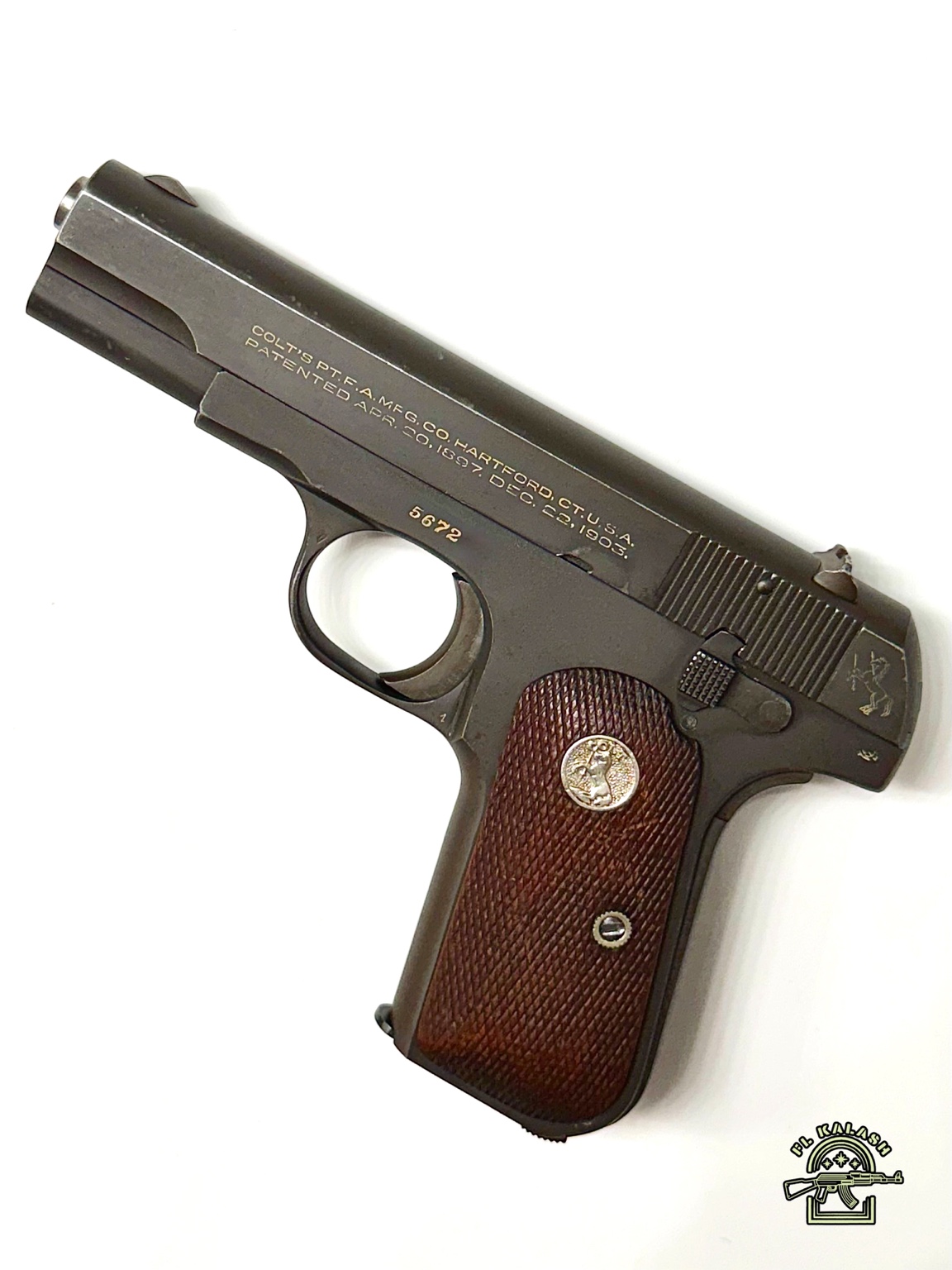
The pistol photographed for this article carries the classic Colt markings associated with the Model M family. The left side identifies Colt's Patent Fire Arms Manufacturing Co. of Hartford, Connecticut, while the slide carries the historic patent dates associated with Browning's design. The frame bears the U.S. PROPERTY marking that identifies it as government property rather than an ordinary commercial pistol.
The Model 1903 designation can cause confusion because Colt's Pocket Hammerless family included both the .32 ACP Model 1903 and the very similar .380 ACP Model 1908. The pistol shown here is the .32 ACP Model 1903. Contemporary references and collector literature commonly call the family the Model M or Pocket Hammerless.
Late-war production also shows that Colt was adapting the design to wartime manufacturing realities. References documenting the U.S. contract pistols note changes around October 1944, including larger sights, an increase in slide serrations from 17 to 19, and a change from blued to phosphated finishes on the .32-caliber military examples. Those details are useful when evaluating a wartime specimen because they help distinguish production periods rather than treating every Model 1903 as identical.
How many were actually purchased?
The wartime government acquisition program was substantial but still small compared with Colt's enormous commercial production. Research by Forgotten Weapons documents 17,330 Colt Pocket Hammerless pistols purchased in .32 ACP during World War II, along with another 3,113 in .380 ACP. The .32-caliber wartime examples fall within a late serial-number range, and surviving pistols can be found with both direct-contract and dealer-procurement histories.
These figures help explain why a U.S. Property marked Model 1903 is historically significant without being described as a conventional infantry sidearm. The pistols were acquired for specialized purposes rather than as a replacement for the M1911. Documentation places them primarily with military police and intelligence-related users, including the Office of Strategic Services.
The OSS connection
The OSS was created on June 13, 1942, after President Franklin D. Roosevelt's earlier Coordinator of Information organization was placed under the Joint Chiefs of Staff structure. The National Archives describes the OSS as a wartime intelligence organization with branches responsible for intelligence collection, analysis, counterintelligence, special operations and support for resistance activities.
That mission created a very different equipment requirement from that of a conventional infantry formation. An intelligence officer, investigator, courier or clandestine operative could have reasons to favor a compact sidearm over the larger standard service pistol. The Colt's small footprint was one of the characteristics that made the design useful in those environments.
There is direct surviving evidence connecting individual U.S. Property marked Model 1903 pistols to the OSS. In one documented example, Colt records identify a pistol as having been delivered to the OSS. A separate documented case involving OSS Sergeant Frederick Mayer records a U.S. Property marked Model 1903 delivered to the OSS property officer in August 1944. Mayer later carried the pistol during his wartime intelligence work in Europe.
That evidence is important because it separates documented history from collector folklore. The Model 1903's association with intelligence personnel is real, but a U.S. Property marking by itself does not prove that any particular surviving pistol was carried by the OSS. Establishing a specific agency, unit or individual requires additional documentation such as factory records, issue records, provenance, photographs or other contemporary evidence.
General officers — an important distinction
The Model 1903 family is also closely associated with U.S. Army general officers during and after World War II. However, the historical record deserves a little precision here.
In 1944, the Army established a formal practice of presenting general officers with a sidearm as a badge of rank. The pistol selected for this presentation role was the .380 ACP Colt Model M, commonly called the Model 1908. The .32 ACP Model 1903 shown in this article belongs to the same Pocket Hammerless family and later .32-caliber examples did appear in general-officer service, but the 1944 presentation program itself centered on the .380.
That distinction matters when researching a U.S. Property marked .32. It would be inaccurate to automatically label every 1944 .32-caliber military-contract Colt as a general officer pistol. Individual examples can certainly have exceptional histories, but the designation should be supported by provenance rather than inferred from the marking alone.
A discreet pistol for specialized work
The Colt's wartime importance comes from its role at the edges of the conventional military system. It was not designed to replace the M1911A1, and it was not a frontline infantry pistol. Instead, it occupied a niche where compactness, familiarity and ease of carry mattered.
That niche included military police and intelligence personnel, and wartime procurement records show the pistol's distribution extended beyond the United States. Forgotten Weapons' research notes that roughly one-third of the .32-caliber government-purchased pistols were sent to Britain for use by the Special Operations Executive, the British organization responsible for supporting resistance movements and conducting clandestine operations in occupied Europe.
The connection between the American Model 1903 and Britain's clandestine war is therefore more than a modern collector's interpretation. Government procurement, surviving examples and documented individual histories place the little Colt within the much larger Allied intelligence and special-operations supply network.
Why the 1944 examples matter to collectors
For today's collector, the most compelling feature of a wartime Model 1903 is often not rarity in isolation but the combination of design, markings and documentary context. The U.S. Property stamp establishes government ownership. The serial number can help place an example within the wartime production range. Factory configuration and finish can provide additional clues about when it was made. And a factory letter or period documentation can transform a military-marked pistol from an interesting object into a documented historical artifact.
The lesson is familiar across military collecting: markings are the beginning of the research, not the conclusion. A pistol can be unquestionably wartime and still have an uncertain individual history. Conversely, a surviving document can establish a connection that the physical markings alone could never reveal.
A small pistol with a large wartime story
The Colt Model 1903 Pocket Hammerless is easy to overlook beside the M1911A1, Garand and Thompson. Yet its wartime story shows how diverse the American small-arms system became between 1941 and 1945. The U.S. military and its associated intelligence organizations needed more than one kind of handgun, and the compact Colt filled a specialized role that conventional service pistols could not always fill as conveniently.
A 1944 U.S. Property marked Model 1903 therefore represents more than an old pocket pistol. It is a physical reminder of the less visible side of American wartime logistics — government procurement, intelligence work, military policing and the thousands of personnel whose jobs required equipment suited to circumstances outside the conventional battlefield.
This article is a historical feature based on the photographed pistol and published historical research. The photographs do not, by themselves, establish a specific wartime unit or individual assignment for this example. Where an OSS or general-officer connection is discussed, the article distinguishes documented examples and procurement history from assumptions about an individual surviving pistol.
National Archives — OSS Records →
American Rifleman — General Officer's Pistols →
Forgotten Weapons — Colt 1903 in U.S. Military Service and for the OSS →
Rock Island Auction — OSS Sgt. Frederick Mayer's Colt Model 1903 →