A service pistol built for war
Few American military firearms are as recognizable as the M1911A1. Its long slide, straight-sided frame, grip safety and .45-caliber chambering became familiar symbols of American military service. Yet the pistol's wartime story is about much more than its appearance. The M1911A1 became a case study in American industrial mobilization, with multiple manufacturers producing a standardized military sidearm on a scale that would have been difficult to imagine only a few years earlier.
The M1911A1 was not a completely new pistol when the United States entered World War II. Its lineage began with the original M1911, adopted by the U.S. military in 1911 after years of testing and development. John Moses Browning's design had already established itself during World War I, and the 1926 M1911A1 changes refined the pistol without fundamentally altering its identity.
Among the better-known changes were a shorter trigger, relief cuts behind the trigger, an arched mainspring housing, a modified grip safety and a shorter hammer spur. These details are subtle, but they help explain why the M1911A1 can look nearly identical to an earlier M1911 while still representing a distinct standardized model.
America's industrial mobilization
Before World War II, the United States maintained relatively modest military forces and had large stocks of existing M1911 pistols. The situation changed rapidly after 1941. The Army and Marine Corps needed enormous quantities of small arms as the American military expanded, and existing government stocks could not simply be treated as an unlimited supply.
Colt resumed wartime production, but the government also brought additional manufacturers into the program. Remington Rand, a company better known for business machines and typewriters, became the largest wartime producer. Ithaca Gun Company also entered production, while Union Switch & Signal and Singer contributed smaller quantities.
The result was a fascinating manufacturing story: different American companies produced the same basic military pistol while working within government specifications. The model designation remained the same, but manufacturing details could vary as factories, suppliers, materials and production methods changed.
The 1943 Colt M1911A1
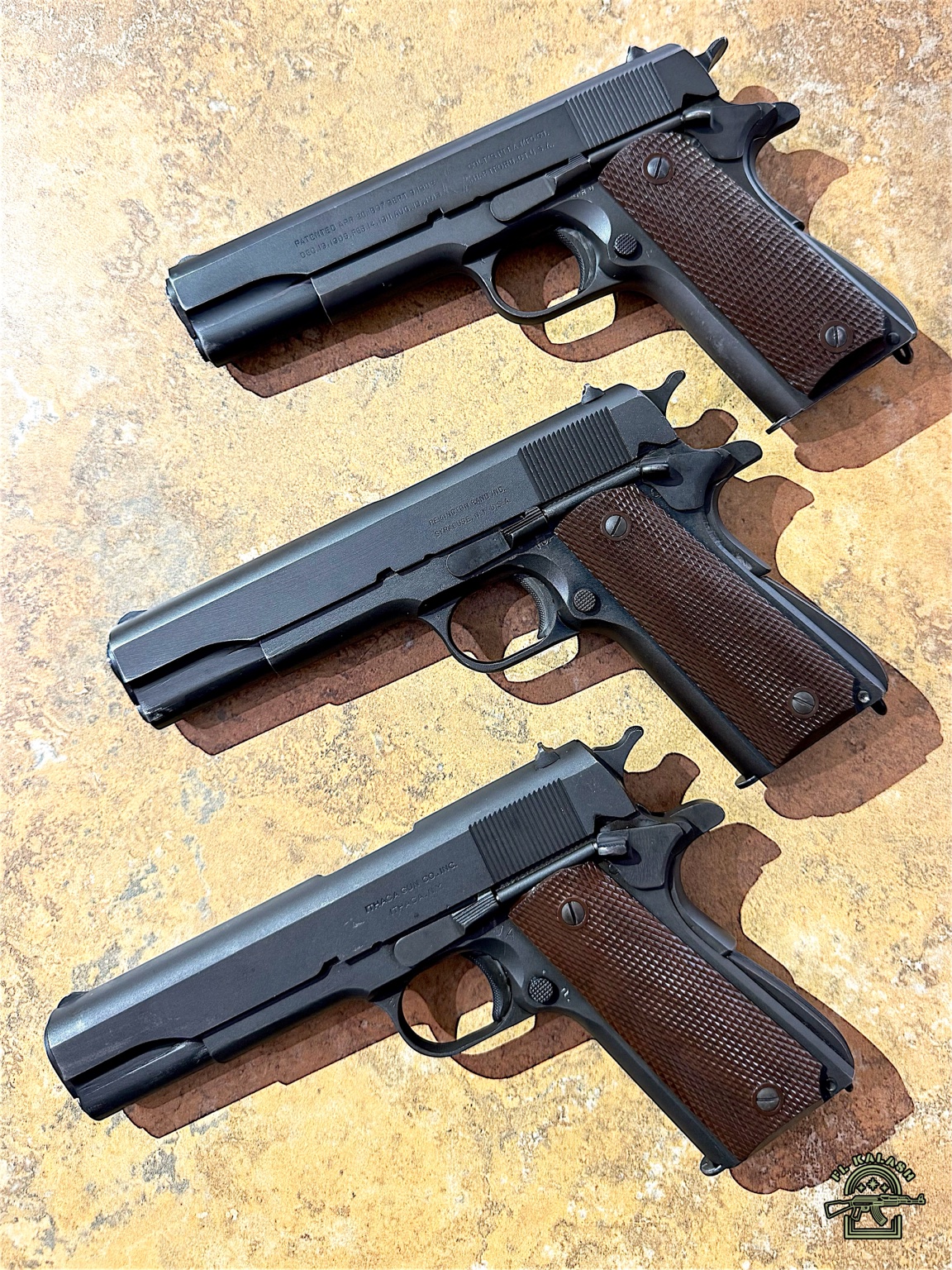
The top pistol in this photograph is a 1943 Colt M1911A1. Colt's relationship with the pistol reaches back to the beginning of the M1911 program, making a wartime Colt an important link between the original service pistol and the mass-production environment of World War II.
Colt produced roughly 400,000 M1911A1 pistols during World War II. In absolute terms, that was only part of the total wartime requirement, but Colt's historical importance was considerably larger because the company had long experience with the design and its production.
A wartime Colt can therefore be viewed as both a military sidearm and an artifact of the transition from prewar manufacturing to full wartime output. By 1943, the American production system was operating under enormous pressure. The priority was dependable equipment in quantity, not the hand-finished character associated with commercial firearms from an earlier era.
The 1944 Remington Rand M1911A1
The middle pistol is a 1944 Remington Rand M1911A1, and its manufacturer's story is one of the clearest examples of wartime American industrial adaptation.
Remington Rand Corporation should not be confused with Remington Arms. Remington Rand was primarily associated with business machines, including typewriters. Its entry into M1911A1 production demonstrates how the wartime economy expanded beyond traditional firearms companies and used the capabilities of established American manufacturers wherever they could be adapted to military production.
Remington Rand began M1911A1 production in 1942 at its Syracuse, New York, facility. The company initially encountered challenges associated with producing a precision military pistol and maintaining interchangeability, but production expanded dramatically after those problems were addressed.
Ultimately, Remington Rand produced roughly 900,000 M1911A1 pistols, making it the largest wartime producer of the type. That makes the 1944 example particularly representative of the industrial side of the M1911A1 story: a company outside the traditional firearms industry became the single largest producer of America's standard .45 service pistol.
The 1943 Ithaca M1911A1
The bottom pistol is a 1943 Ithaca M1911A1, shown here as a double-stamped example. Ithaca Gun Company was already an established firearms manufacturer before the war, best known for sporting arms, but the company's wartime role illustrates how even experienced firearms makers had to adapt their production to military requirements.
Ithaca began M1911A1 production in late 1942 and eventually produced hundreds of thousands of pistols for the government. As with the other contractors, production emphasized standardization, interchangeability and efficient manufacturing rather than the characteristics of a commercial sporting arm.
The double-stamped appearance of an individual pistol is exactly the kind of detail that attracts collector attention. Wartime markings can provide clues about manufacture, inspection and subsequent history, but individual markings should be interpreted in context. A stamp or marking by itself does not automatically establish the complete service history of a pistol.
Three manufacturers, one military standard
Placed together, these three pistols demonstrate an important feature of wartime collecting. They are products of different manufacturers, but they belong to the same U.S. military procurement system.
The government established requirements for the M1911A1, and contractors had to produce pistols that met those requirements. That created a balance between standardization and variation. The soldier needed a dependable service pistol; the factory needed a practical way to manufacture that pistol repeatedly and efficiently.
As a result, collectors can encounter differences in markings, finishes, component characteristics and other manufacturing details without those differences necessarily indicating that one pistol is incorrect. In many cases, the differences are evidence of the manufacturing environment itself.
The M1911A1 in the American war machine
The scale of wartime M1911A1 production is easier to understand when placed alongside the rapid expansion of the American military. The United States created and equipped a force that would operate across Europe, North Africa and the Pacific. Small arms production had to keep pace with that expansion.
The M1911A1 remained an important sidearm even as other weapons, particularly the M1 Carbine, entered enormous production. Soldiers, Marines, officers, vehicle crews, pilots and other personnel could encounter the .45 in a wide variety of roles.
By the end of World War II, approximately 1.88 million M1911A1 pistols had been procured. That number makes the pistol not merely a famous military design, but one of the clearest examples of the scale of American small-arms production during the conflict.
A wartime pistol is not always a frozen snapshot of its production year
One of the most important lessons for collectors is that the date or manufacturer on a pistol does not necessarily describe every component currently present on that pistol.
The U.S. military already possessed large numbers of earlier M1911 pistols when World War II began. Pistols were inspected, repaired, refurbished and returned to service. Components could be replaced during maintenance, and later arsenal work could alter the configuration of an individual example.
That is why claims such as “all original,” “matching” or “factory correct” deserve careful examination. A 1943 frame does not automatically prove that every component on the pistol was installed in 1943. Likewise, a manufacturer's marking should not be treated as proof that the pistol remained untouched throughout its military life.
For collectors, the most useful approach is to document the firearm as it exists today and then compare its markings and components with reliable references. Serial numbers, manufacturer markings, inspection marks, finish, component characteristics and provenance can all contribute to the larger picture.
Reading the M1911A1 as a historical object
The M1911A1 can be studied on several levels. At the most basic, it is a historic American service pistol. Look deeper and it becomes an example of John Browning's design philosophy. Look deeper still and it becomes a record of American industrial production.
An individual pistol can also preserve clues about military logistics, inspection and maintenance. That is why seemingly small details matter to collectors. A manufacturer's name can identify who produced the pistol. A serial number can help establish its place within production. Inspection markings can provide evidence of government acceptance. Later markings may point toward subsequent maintenance or rebuild activity.
None of these details should be interpreted in isolation. Historical firearms are best understood by combining physical evidence with period documentation and credible reference material.
A legacy that continued after 1945
The M1911A1 did not disappear when World War II ended. The United States had accumulated a huge inventory of pistols, and those guns continued to serve for decades. Many would be inspected or rebuilt more than once during their government service.
That longevity is a major part of the pistol's historical significance. A design adopted in 1911 remained an important American military sidearm through two world wars and well into the Cold War era.
For collectors today, that means a wartime M1911A1 can represent several different stories at once: the history of Browning's design, the wartime production system, the military organization that issued it and the individual history of the surviving example.
Three pistols, one American story
The 1943 Colt, 1944 Remington Rand and 1943 Ithaca shown here are three individual examples of a much larger story.
The Colt represents the original manufacturer of the design. The Remington Rand represents the extraordinary expansion of American industrial capacity during World War II. The Ithaca represents an established firearms company adapting its manufacturing capabilities to a national wartime requirement.
Together, they show how the United States transformed a prewar service pistol into a mass-produced wartime sidearm. Their differences are not simply collector curiosities. They are evidence of how factories, suppliers, workers and military procurement systems responded to the demands of total war.
That is what makes the wartime M1911A1 more than a collectible firearm. It is a physical record of American industrial history—one that can still be read through its markings, manufacturing characteristics and provenance more than eighty years later.
READER DISCUSSION
Have something to add?
Share a historical observation, correction, research lead or perspective related to this article. Comments are reviewed by the editor before publication.