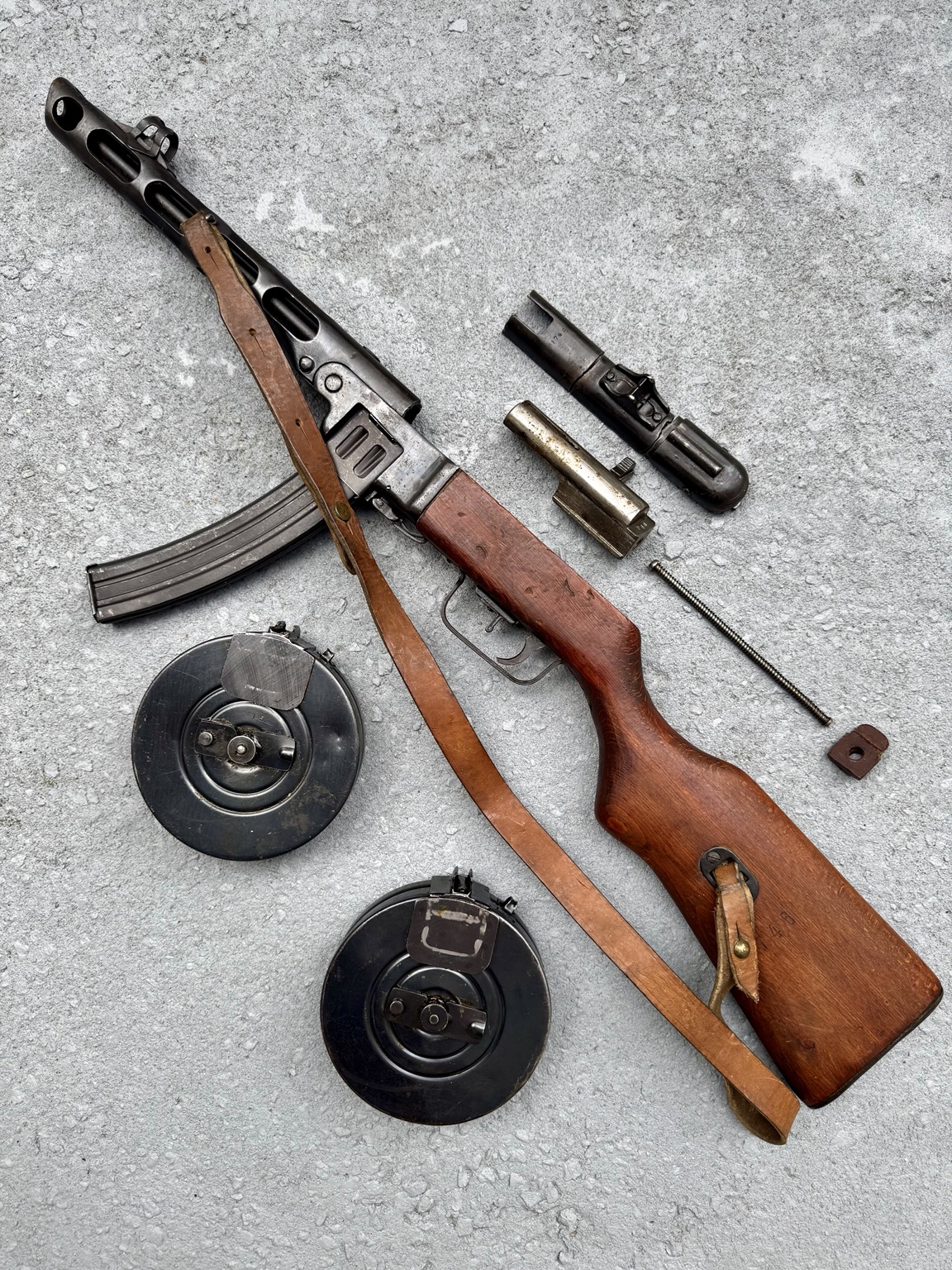
An icon of Soviet wartime production
Few small arms are as immediately associated with the Eastern Front as the PPSh-41. Its distinctive perforated barrel shroud, curved profile and large drum magazine became familiar symbols of Soviet infantry during the Second World War. Behind that recognizable silhouette is a larger story about industrial mobilization, simplified manufacturing and the Soviet Union's effort to equip a rapidly expanding army.
The PPSh-41 was designed by Georgy Shpagin and adopted in 1940. Its development reflected lessons from the Winter War and the Red Army's experience with earlier submachine guns. The objective was not simply to create a new weapon, but to create one that could be produced in enormous quantities with manufacturing methods that reduced the need for extensive machining and highly specialized labor.
That production philosophy is one reason the PPSh remains such an interesting historical artifact. Looking at an original wartime example—or a preserved parts kit—can reveal the practical decisions made by Soviet factories under the pressure of total war.
1944: A year of mature production
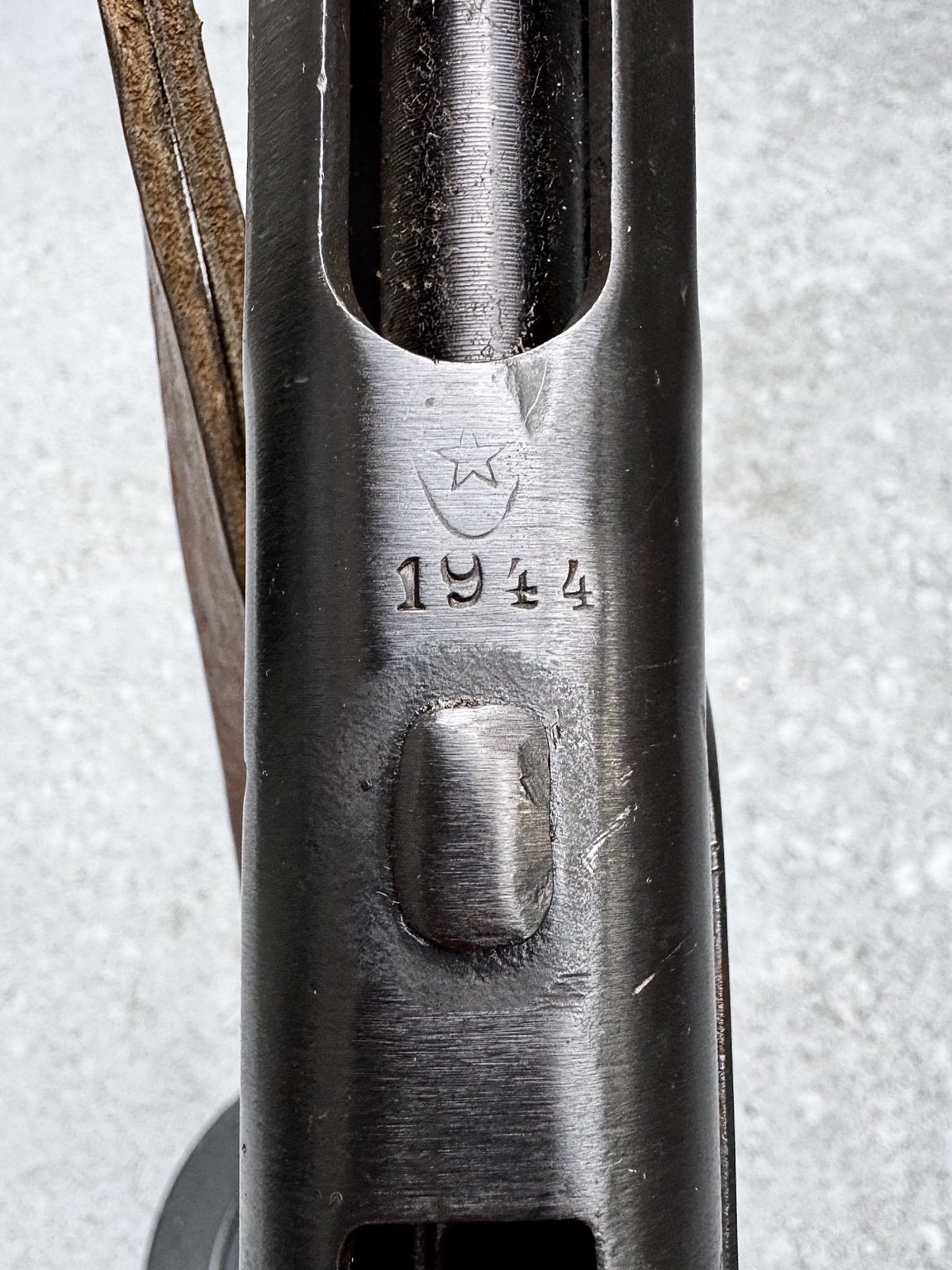
The date visible on this example is 1944, placing it in the later period of wartime PPSh production. By then, the program had moved far beyond the emergency production of 1941 and 1942. Soviet factories had refined their methods, production networks had matured and the design had accumulated recognizable late-war characteristics.
Production was spread among multiple Soviet factories, but the plant associated with factory No. 367 at Vyatskiye Polyany—later closely associated with the Molot name—became the principal producer. The factory had been relocated eastward during the German advance in 1941, taking equipment and skilled personnel with it. That evacuation was part of a much broader Soviet effort to move critical industrial capacity away from areas threatened by German forces.
By the middle and later years of the war, the relocated industrial base was producing enormous quantities of small arms. Published production research places factory No. 367 among the largest PPSh manufacturers, with hundreds of thousands of examples produced during individual wartime years. The scale is difficult to appreciate from one individual kit, but that is exactly what makes surviving examples interesting: each one is a physical remnant of a huge industrial system.
Reading the factory marking
One of the most interesting details in these photographs is the marking visible above the date. The star-in-shield style mark is associated with the Vyatskiye Polyany production system, the factory complex that became the major wartime PPSh producer and is closely associated with the later Molot name.
Factory markings are valuable because they can connect an individual object to the industrial history that produced it. A date can establish a manufacturing year, while a factory symbol can point toward a production site. Serial numbers, component markings and construction details can then add another layer to the record.
It is important not to treat one marking as the entire story. Soviet wartime production was highly decentralized, and components could pass through different stages of manufacture or be replaced during service. A responsible collector documents every visible marking and considers the complete group of evidence rather than forcing an identification from one symbol alone.
The PPSh's manufacturing philosophy
The PPSh is an especially good case study in wartime manufacturing. Earlier Soviet submachine guns such as the PPD relied more heavily on machined components. Shpagin's design moved toward stamped sheet metal and simplified construction, allowing production to expand dramatically.
Historical references commonly describe the PPSh as consisting of roughly 87 components, with a significant portion fabricated from pressed steel. Even seemingly complicated features were approached with production efficiency in mind. The barrel shroud, for example, served multiple purposes while being made from sheet metal. The receiver and shroud arrangement protected the barrel while also contributing to the weapon's distinctive appearance.
The PPSh's barrel production also reflected wartime economy. Historical sources note that Mosin-Nagant rifle barrels could be cut and adapted to produce PPSh barrels, allowing Soviet factories to make efficient use of existing material and manufacturing capacity. These decisions illustrate an important principle of wartime arms production: a successful military arm has to be manufacturable at scale.
From drums to box magazines
The large drum magazine is probably the PPSh feature most recognizable to the public. The original drum held 71 rounds and gave soldiers substantial ready ammunition. It also introduced practical complications. Drums were more complicated to manufacture, could be time-consuming to load and could create reliability problems when fit or condition was poor.
Those experiences helped drive adoption of the curved 35-round box magazine. The box magazine was simpler to manufacture and easier to carry, and it became increasingly common as the war progressed. The transition is another example of Soviet wartime engineering favoring practical production and field utility over a single iconic configuration.
The two drum magazines visible in the photograph are therefore more than accessories surrounding the main receiver. They are part of the historical story of the PPSh system and the logistical choices that shaped how Soviet soldiers carried and supplied their weapons.
What a parts kit preserves
A parts kit has a different character from a complete firearm. The separation of components exposes details that are normally hidden when the object is assembled. Receiver markings, machining marks, finish variations, wood condition and individual component numbers can become easier to photograph and document.
For a collector, that makes a kit valuable as a historical object. The photographs accompanying this article show the receiver and associated components as acquired, including the wooden stock, barrel and shroud components, bolt-related parts and magazines. Together, they provide a snapshot of an original wartime system rather than simply a photograph of a finished silhouette.
This is also where careful documentation matters. A collector can photograph markings before any cleaning or alteration, record the condition of the metal and wood, and keep original packaging, paperwork or seller documentation associated with the purchase. Those records can become part of the item's provenance and help future researchers understand exactly what was present at acquisition.
A closer look at the photographs
The first photograph shows the overall group and gives a sense of how much of the original system remains together. The worn wood, aged finish and separate metal components communicate something that a pristine reproduction cannot: this is an object that has survived decades since the war.
The second photograph focuses on the factory/date area. The 1944 marking is immediately readable, while the factory symbol above it provides the starting point for researching the manufacturing history. Close-up photography is especially useful because small marks can disappear in a full-object photograph.
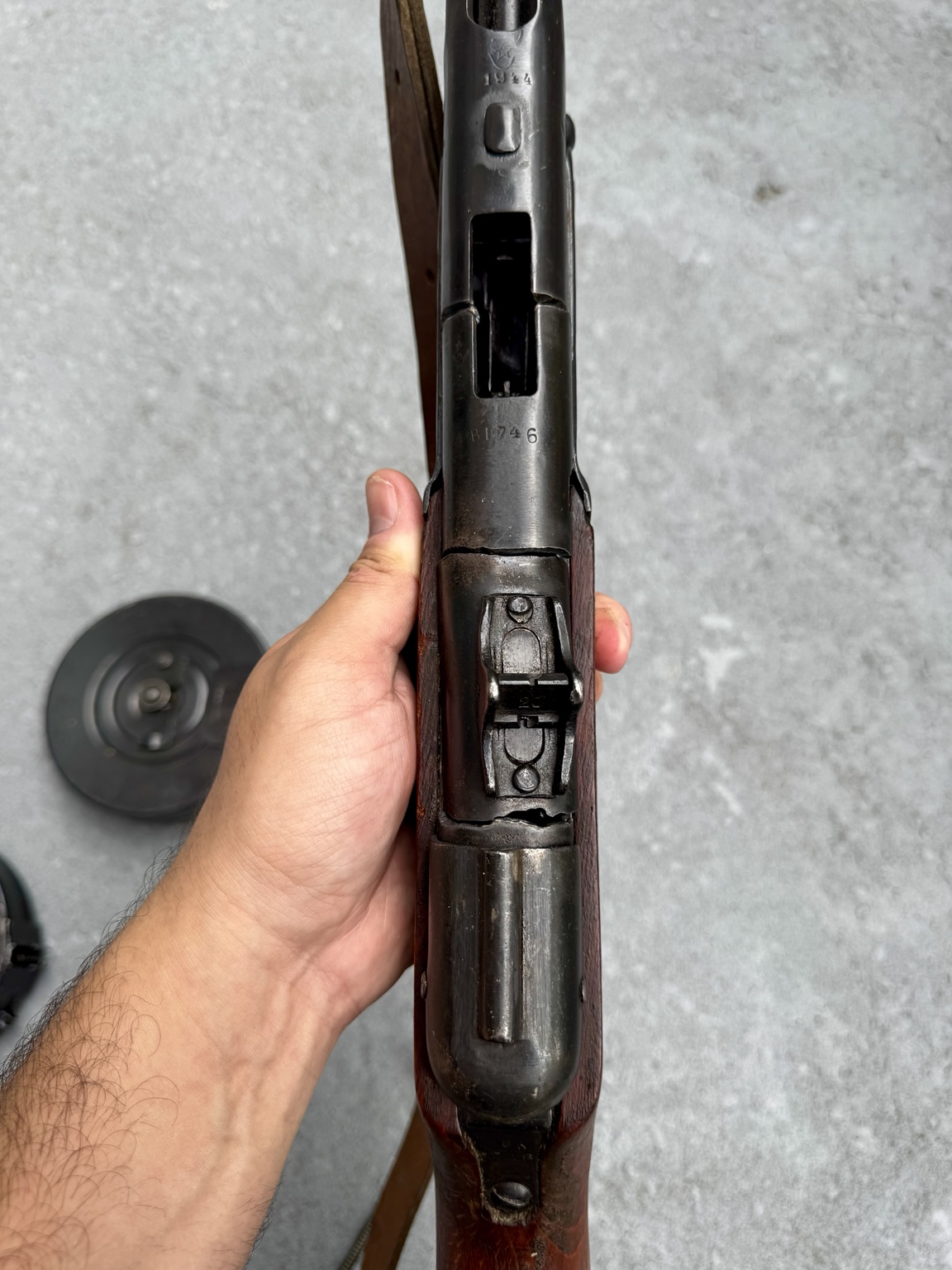
The third photograph looks down over the receiver area and associated components. Details such as finish, component relationships and surviving markings can all become part of a collector's research file. None of those observations alone tells the entire story, but together they build a much stronger record.
The Eastern Front in metal and wood
The PPSh's historical importance extends beyond its technical design. It was produced during one of the largest and most destructive conflicts in modern history and became closely associated with Soviet infantry operations from the early years of the German-Soviet War through the Soviet advance into Central Europe.
Its widespread use also meant that the PPSh became a symbol of the Red Army's enormous wartime mobilization. The firearm was not an isolated technological achievement. It was the product of a system involving factories, evacuated machinery, raw materials, tooling, workers, inspectors, transport networks and enormous ammunition requirements.
That context is what makes a 1944-dated example compelling to a collector. The date is not simply a number stamped into steel. It places the object in a specific phase of the Soviet war effort, when the PPSh had become a mature and extensively produced military system.
Why this kit caught my attention
I purchased this 1944 Molot PPSh-41 parts kit from Moka's Raifus because of the historical character preserved in the group. What immediately stood out was the combination of the wartime date, the factory marking, the surviving wood and the collection of original components.
For Florida Kalash Media, pieces like this are interesting because they allow the story of a firearm to be told through physical evidence. Rather than treating a historic firearm as simply an object to photograph, the goal is to document the markings, production context and surviving features that connect it to the period in which it was made.
The PPSh is especially well suited to that approach. Its history touches industrial relocation, mass production, Soviet small-arms design, Eastern Front combat and the evolution of military logistics. Even in parts-kit form, the surviving components carry enough information to open a much larger historical discussion.
Documenting a wartime survivor
The most rewarding part of collecting historic firearms and military small arms is often the research that follows an acquisition. A date leads to a factory. A factory leads to a production history. A serial number may lead to a reference range. A magazine or small component may reveal another layer of the story.
The best collection records do not simply say what an object is; they explain why the collector believes it is what they believe it is. Clear photographs, careful observations and reputable references create a record that can be revisited years later.
This 1944 Molot PPSh-41 kit is a good example. The photographs preserve the object's condition as acquired, the visible markings provide a starting point for research and the broader production history explains why those details matter. It is one small surviving piece of a much larger Soviet wartime industrial story.