Two pistols, one remarkable period
Among the most compelling pieces of Second World War militaria are the firearms that came home with the men who encountered them. Often called “bring-backs,” these souvenirs can preserve a personal connection to the war that government records alone cannot provide. They also present an interesting research challenge: a pistol's manufacture date, markings and wartime use are not necessarily the same thing as the story attached to it.
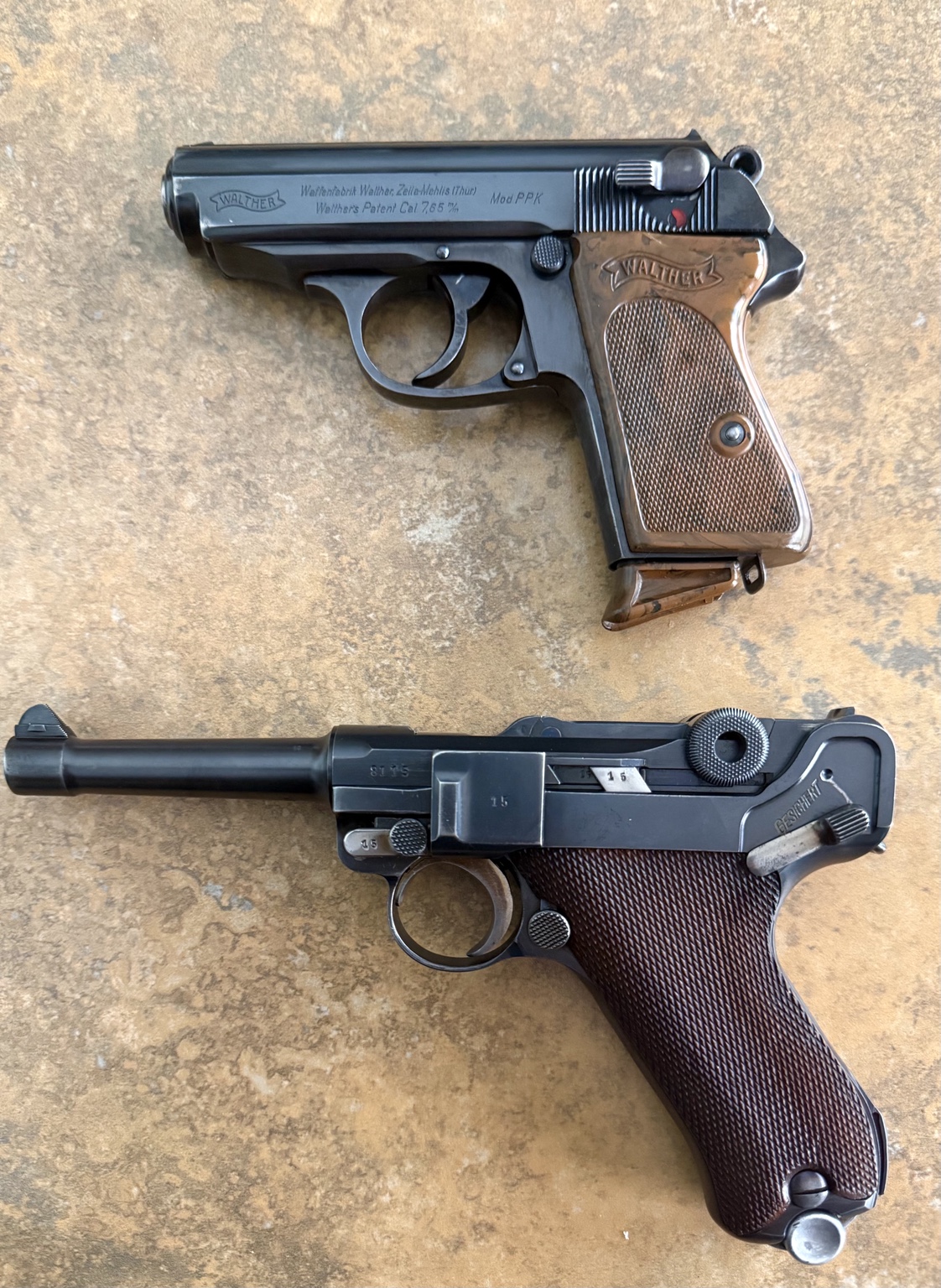
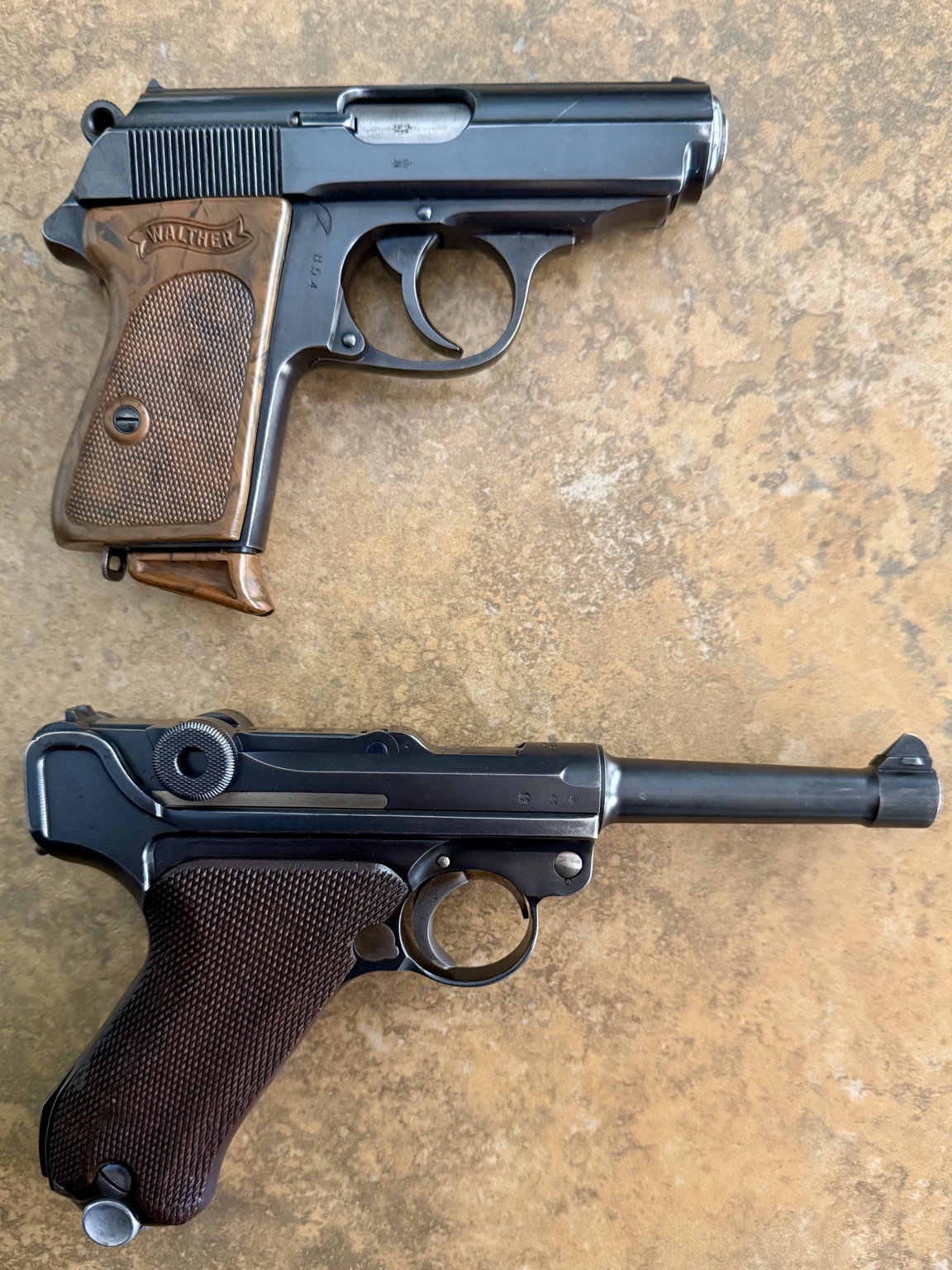
The two pistols pictured here are excellent examples. The upper pistol is a 1935 Walther PPK, a compact pre-war design developed from Walther's successful PP. Below it is a 1936 Mauser P.08 Luger, an early rearmament-era example of one of Germany's most recognizable military pistols. Both predate the Second World War, yet both belong to designs that would remain closely associated with German military, police and government service during the conflict.
That pre-war dating is what makes the pair especially interesting. These were not hurried late-war products. They were made during the period when German firearms manufacturing was moving from the constraints of the interwar years toward large-scale rearmament.
The 1935 Walther PPK
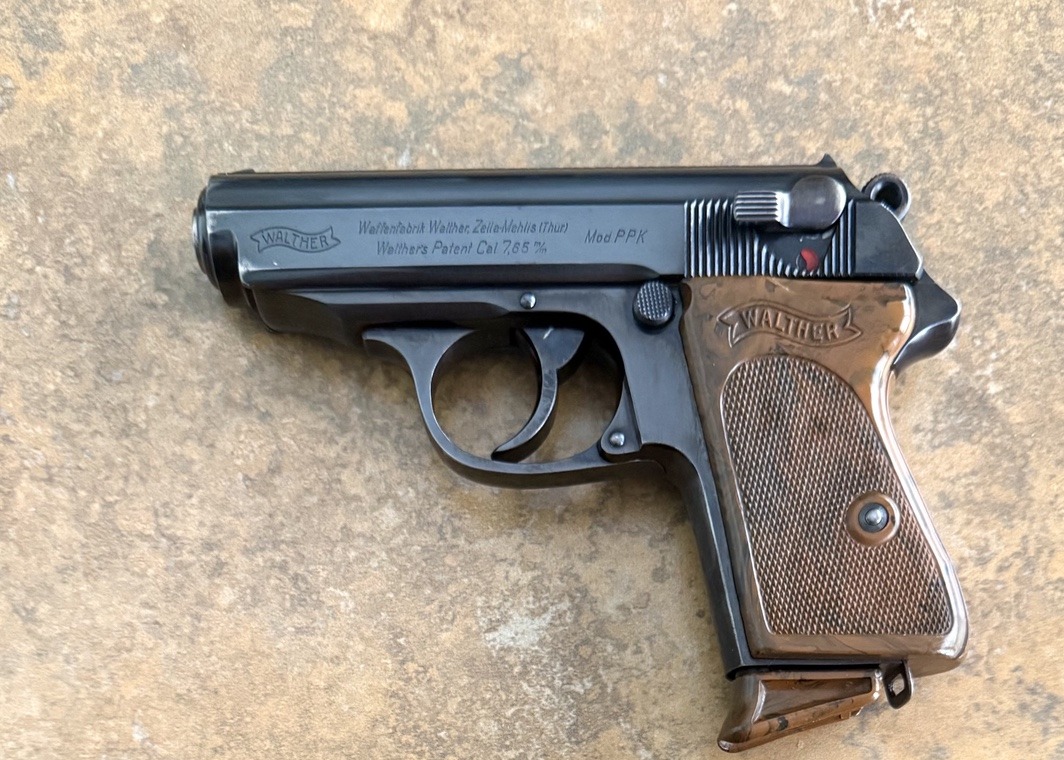
Walther introduced the PPK in 1931 as a compact member of the PP family. The initials are generally understood as Polizeipistole Kriminal, reflecting its intended association with criminal-investigation police and discreet official carry. Walther's own modern historical material describes the PPK as a design created around the need for a compact, reliable pistol suitable for concealed carry.
The PPK was smaller than the original PP, particularly around the grip and overall frame dimensions. The design retained Walther's double-action/single-action operating concept and fixed-barrel blowback arrangement. In its classic pre-war configuration, the pistol was commonly chambered for 7.65 mm Browning (.32 ACP), a cartridge that was widespread among European police and commercial pocket pistols.
The pictured pistol is marked 1935 by its documented collection identification and retains the distinctive pre-war Walther appearance: finely checkered brown grip panels, compact proportions, and the characteristic Walther slide and safety arrangement. Its small size was a major part of the PPK's appeal. It was not intended to compete with a full-size military sidearm; it occupied the space where discretion and portability mattered more than heavy service-pistol dimensions.
From police pistol to wartime icon
When Germany entered the Second World War, the PPK was already an established design. Its association with police and government users continued, while examples were also encountered among military and other official personnel. The pistol's small size made it particularly suited to situations where a full-size service pistol was unnecessary or inconvenient.
It is important, however, not to turn the PPK into a single-purpose “Nazi pistol.” The model had a broad civilian, police and government history before and during the war. A 1935 example was manufactured before the conflict and does not, by date alone, establish who carried it during the war. Specific wartime use requires specific evidence such as issue markings, documents, photographs or provenance.
The 1936 Mauser P.08
The Luger occupies an entirely different place in German firearms history. The P.08 had been Germany's standard military pistol since the Imperial era, and its distinctive toggle action made it one of the most recognizable military handguns of the twentieth century. After the First World War, production was constrained by the Versailles system, but German Luger production resumed under the Weimar government and expanded significantly as Germany rearmed in the 1930s.
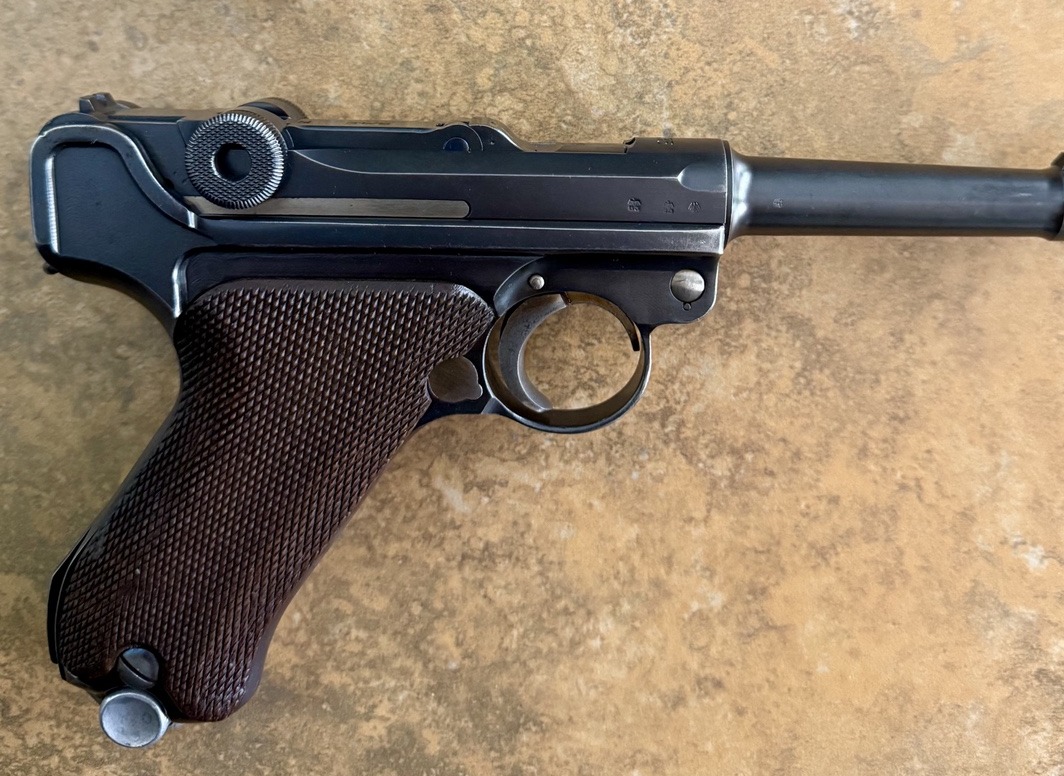
By the mid-1930s, Mauser-Werke at Oberndorf am Neckar had become the principal German producer of the P.08. Collector research places approximately 89,500 Mauser P.08 pistols in 1936 production, making that year an important point in the transition from interwar manufacture to the rapidly expanding German military system.
The pistol shown here is identified as a 1936 Mauser P.08. Its chamber date places it firmly in the early rearmament period. That timing is significant: Germany was expanding its armed forces, and the P.08 was still being produced in substantial numbers even as newer service-pistol designs were being developed.
Why the 1936 Luger matters
The 1936 P.08 is particularly interesting because it sits near the end of the Luger’s long military production story. The basic design was already decades old, yet German authorities continued to procure it while the P.38 was being developed as a more modern service pistol.
Mauser production also illustrates how deeply collectors can read a historical pistol. Manufacturer codes, chamber dates, serial-number suffixes, inspection stamps and the relationship between numbered components can help establish when and where a P.08 was produced. Surviving examples are therefore more than recognizable shapes: they are documents in steel, wood and markings.
Bring-backs and the American collector tradition
During and immediately after the Second World War, Allied servicemen returned home with souvenirs from Europe. Pistols were among the objects that could become tangible reminders of military service, although the circumstances under which individual firearms were acquired varied widely.
For a collector today, “bring-back” is best treated as a provenance statement rather than a technical classification. A German pistol made in 1935 or 1936 could have served in many places and with many organizations before eventually becoming a wartime souvenir. The strongest stories are those supported by documentation: a veteran's account, photographs, capture paperwork, letters, unit records or a continuous family history.
That distinction is especially important with Lugers and Walthers because both models remained popular for decades after their original manufacture. A pistol's age can tell us when it was made; it cannot, by itself, tell us where it traveled during the war.
Reading the pair together
Placed side by side, these two pistols show how broad the German handgun landscape was before the war. The PPK represents compactness, discreet carry and the police/commercial side of German pistol design. The P.08 represents a much older military tradition that continued into the rearmament era.
They also demonstrate why dates matter. Both were manufactured before 1939, but neither should be judged only by its relationship to the war. Their stories begin earlier, during a period of technological development, political change and German rearmament. Their eventual wartime journeys are separate questions — and that is where provenance becomes so important.
Preserving the story
For historical firearms, the most valuable information is often the information that survives alongside the object. Keeping photographs, family notes, veteran correspondence, serial-number documentation and other provenance together with the firearm can preserve context for the next generation.
For collectors researching a PPK or P.08, the basic research path is straightforward: document every visible marking, establish the manufacturer's production history for the relevant year, compare the pistol's configuration to known period examples, and separate what the firearm proves from what family history or oral tradition suggests. When a claim cannot be independently documented, it is better to identify it as a claim than to turn it into a certainty.
That approach is particularly appropriate for bring-backs. The object is important, but so is the story attached to it — and careful documentation gives that story the best chance of surviving.