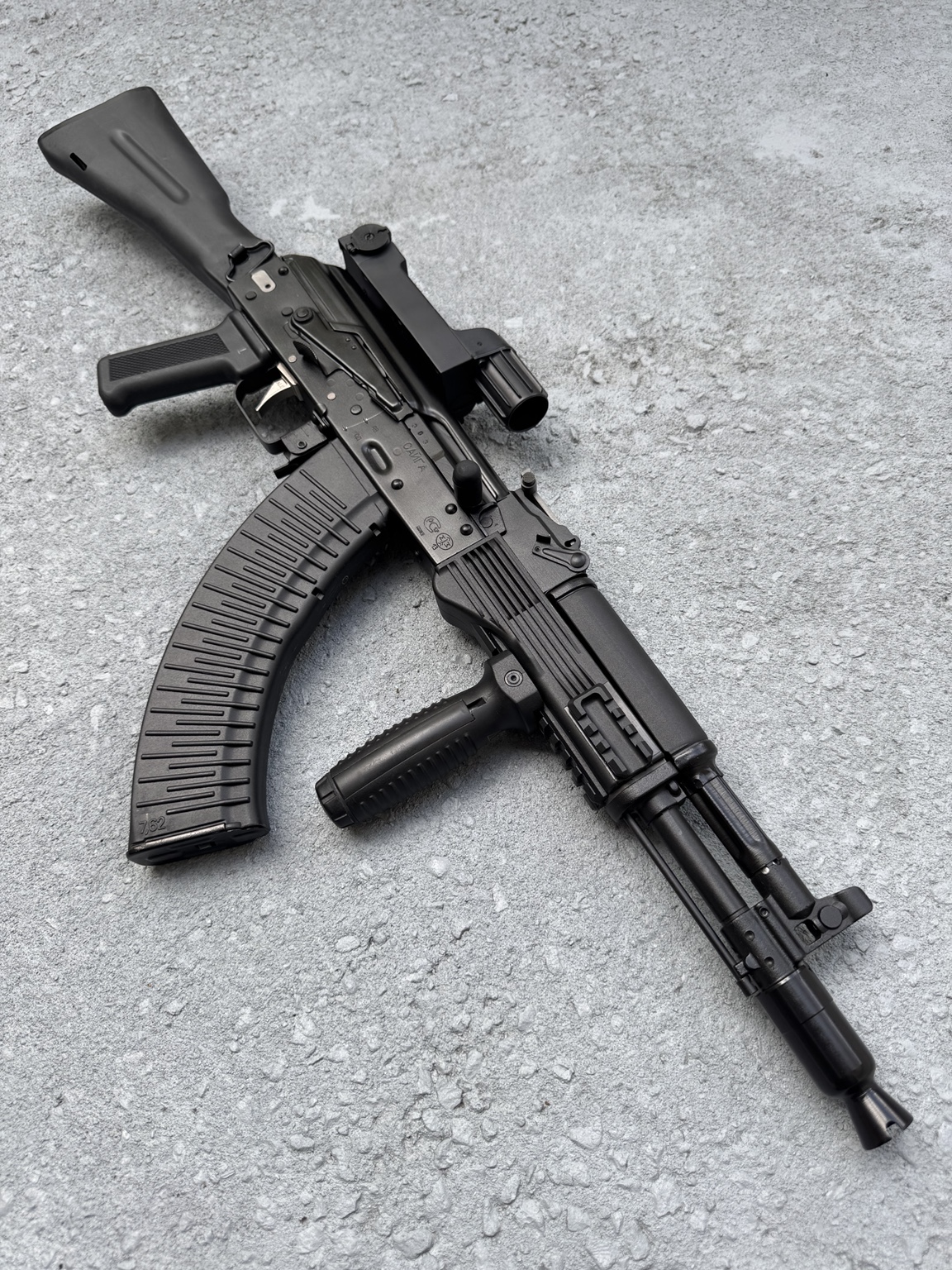
From civilian Saiga to AK-104 configuration
The AK-100 family occupies an important place in the later history of the Kalashnikov system. Developed after the Soviet period, the family brought the familiar Kalashnikov operating concept into a more modern series of rifles and carbines. The AK-104 is the 7.62×39 mm carbine member of that family, sharing the general architecture of the AK-100 series while using a shorter barrel and compact configuration. Contemporary references describe the AK-101 through AK-105 as a family developed around common Kalashnikov components and different chamberings and barrel lengths. Small Arms Review's AK-100 primer provides useful background on the family.
The rifle photographed here has a different story. Rather than being presented as an untouched factory AK-104, this example began life as a Russian Saiga Sporter and was subsequently converted into the configuration shown. That distinction is important to collectors. A factory military rifle, a civilian Saiga and a later conversion may share a recognizable visual language while having very different histories.
Saiga rifles were civilian semi-automatic descendants of the Izhmash Kalashnikov line. Their relationship to the AK-100 family is one of the reasons they became such interesting foundations for collectors who wanted a more military-style appearance while retaining the history of an imported Russian sporting rifle. The result can be a firearm that tells two stories at once: the history of the original civilian import and the history of the later configuration work.
The AK-104 influence
The AK-104 was developed as a compact 7.62×39 mm member of the AK-100 family. Its shorter proportions and black polymer furniture give it a distinctive silhouette compared with a full-length AK-103. Sources on the series place the AK-104 alongside the AK-102 and AK-105 as the shorter-barreled members of the family. Small Arms Review also notes that the AK-9 was a further development of the 100-series concept, making the family particularly interesting when tracing later Russian Kalashnikov design language.
On this rifle, the AK-104 influence is most obvious in the compact overall profile and the combination of Russian-pattern furniture and optics. The goal is not simply to make a rifle look modern. It is to capture a particular period of Russian small-arms design in which the classic Kalashnikov pattern was being adapted to shorter, more specialized configurations.
A Russian Kobra optic
One of the most visually distinctive parts of the rifle is the Kobra red-dot sight. Kobra sights became closely associated with Russian and former Soviet small-arms culture, and their design is immediately recognizable to collectors of ComBloc equipment. Historical coverage of the Kobra has documented its use on a variety of AK-pattern rifles and its compatibility with Russian-style side mounting systems. Small Arms Review's history of the Russian Kobra provides additional context.
On this configuration, the Kobra does more than provide an optic. It reinforces the visual connection to Russian military and export-market Kalashnikovs of the late Soviet and post-Soviet period. The optic, rifle and furniture read as a coherent design language rather than a collection of unrelated modern accessories.
The AK-9 connection
Another unusual detail is the lower handguard, identified for this rifle as a rare AK-9 pattern component. The AK-9 is one of the more specialized members of the broader Russian 100-series family. Developed as a compact 9×39 mm rifle for specialized applications, it carried the Kalashnikov system into a distinctly different role and incorporated its own furniture and accessory arrangements.
The AK-9 is historically interesting precisely because it was never as common as the better-known AK-101 through AK-105 rifles. References describe it as a purpose-built 9×39 mm development of the 100-series family. That makes an AK-9-related furniture component an especially interesting detail on a collector-oriented AK-104 configuration. Here, the handguard gives the rifle a visual connection to one of the more specialized branches of Russian Kalashnikov development.
It is also a good example of why collectors should document individual components rather than relying only on the model name. A rifle may have a recognizable overall configuration while containing a component with its own separate history. Photographing and recording those parts can make the story of the finished firearm much more useful years later.
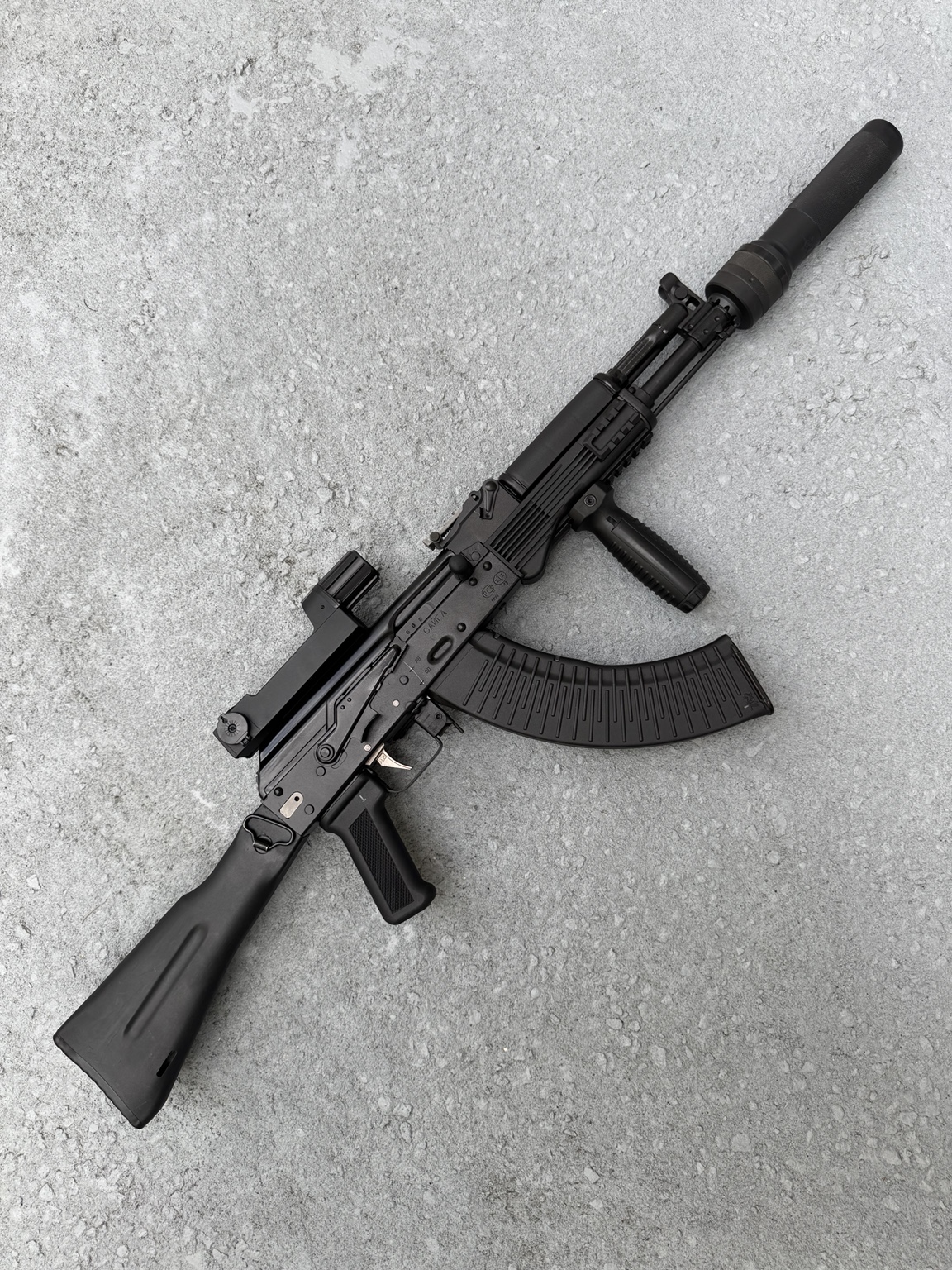
The Dead Air Wolverine
The configuration is completed by a Dead Air Wolverine PBS-1 suppressor. The Wolverine is a modern suppressor designed specifically with the challenges of AK-pattern rifles in mind and takes visual inspiration from the Soviet-era PBS-1. Dead Air's documentation and published technical material describe the Wolverine as a purpose-built solution for AK platforms, while independent testing has discussed the challenges presented by the threaded muzzle and alignment characteristics of some foreign-made AKs. Dead Air's Wolverine manual and Shooting Illustrated's review provide additional background.
For a historical collector feature, the interesting point is the visual and conceptual connection. The Wolverine's appearance deliberately echoes the Soviet PBS-1 aesthetic, creating a bridge between an older ComBloc design language and a modern American-made accessory. It gives this rifle a distinctly post-Cold War character without disguising the fact that the underlying firearm began life as a civilian Russian Saiga.
This article is concerned with the historical and collecting aspects of the configuration, not with installation, tuning or use of suppressors. Firearms and NFA-regulated accessories should always be handled and possessed in accordance with applicable federal, state and local law.
The experimental Molot 40-round magazine
Perhaps the most unusual accessory shown with the rifle is the experimental Molot ribbed 40-round magazine. The magazine adds another layer to the Russian industrial story represented by the rifle. Molot is associated with the Vyatskiye Polyany machinery plant and the broader Russian small-arms industry, and its magazines and firearms have become recognizable subjects among collectors of Russian-pattern equipment.
The ribbed construction gives the magazine a distinctive appearance that immediately separates it from the most familiar 30-round AK magazines. In this collection, it also changes the visual balance of the rifle: the long curved magazine emphasizes the compact proportions of the AK-104-style configuration while reinforcing the Russian provenance of the components.
Because the magazine is described as an experimental Molot example, documentation is particularly important. Experimental, prototype and limited-production components are easy to misidentify when they are separated from their original context. Markings, construction details, provenance and clear photographs can be more valuable than an assumption based solely on appearance. The best collector record should distinguish between what can be directly observed and what is attributed to the item based on prior documentation.
Why the combination matters
What makes this rifle interesting is not any single accessory. It is the way several different pieces of Russian Kalashnikov history have been brought together around a civilian Saiga foundation.
The Saiga represents the civilian and commercial side of the Izhmash story. The AK-104 represents the compact 7.62×39 mm branch of the later 100-series family. The Kobra reflects the Russian optics ecosystem. The AK-9-pattern handguard points toward a specialized 9×39 mm development. The Wolverine provides a modern interpretation of the old PBS-1 visual language. And the Molot magazine adds a separate piece of Russian industrial and collecting history.
Viewed individually, each component is interesting. Viewed together, they create a snapshot of how the Kalashnikov pattern continued to evolve after the Cold War: from military service rifle to civilian import, from standardized service configurations to specialized variants, and finally into the collector world where individual components can be assembled into historically informed configurations.
Documenting a configuration like this
For collectors, photographs are part of the historical record. Overall views should be accompanied by close photographs of receiver markings, serial numbers, manufacturer codes, furniture markings and unusual accessories. If a component is believed to be rare or experimental, documenting it from multiple angles can help future researchers distinguish it from visually similar production items.
It is equally useful to preserve the story of how the configuration came together. Notes about the original Saiga, the conversion history, the provenance of unusual Russian components and the dates on which photographs were taken can provide context that may otherwise disappear over time.
This is particularly important with imported Russian firearms and accessories because the history of availability in the United States has been shaped by changing import conditions and sanctions. A Russian-made firearm that was commercially imported years ago can therefore carry a different collecting story from a later American-made rifle that merely follows the same design.
A modern collector's interpretation of the Russian AK
This Saiga-based AK-104 configuration is ultimately a study in continuity. The Kalashnikov pattern has survived because its basic architecture could be adapted to different cartridges, barrel lengths, users and production environments. The AK-100 family represents one chapter in that evolution, while the civilian Saiga represents another.
The finished rifle takes those histories and presents them through a collector's lens. The Kobra sight, AK-9-pattern lower handguard, Dead Air Wolverine and unusual Molot magazine are not random additions; together they create a configuration that reflects a specific Russian design vocabulary and a specific period of interest in Kalashnikov collecting.
That is what makes a configuration like this worth documenting. It is not simply a rifle photographed for its appearance. It is a collection of details that can be traced back to different corners of Russian small-arms development, brought together around one civilian Saiga foundation.